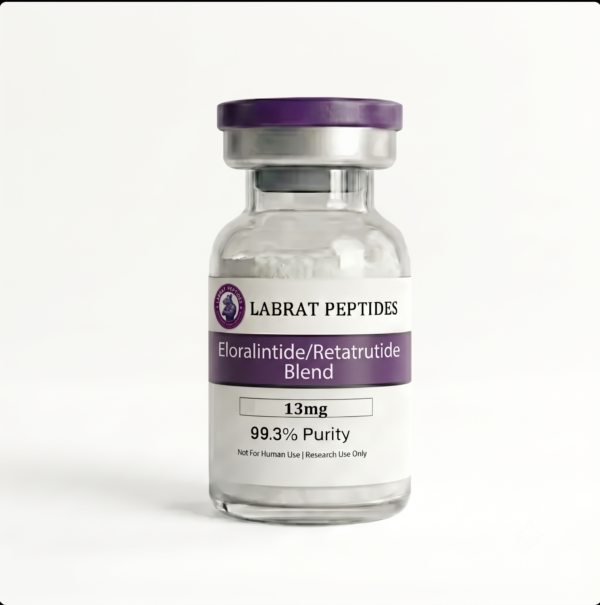
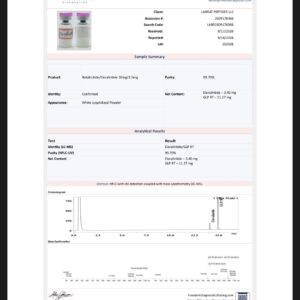
Every batch of Labrat Peptides undergoes third-party Mass Spectrometry and HPLC analysis. We believe in absolute transparency - since in third-party marketing we need complete confidence.
Eloralintide Retatrutide Blend 13mg is a laboratory research material supplied strictly for Research Use Only (RUO) applications. This research peptide blend contains eloralintide and retatrutide, two distinct investigational peptide compounds being studied in metabolic signaling, receptor biology, peptide pharmacology, biochemical research, analytical testing, and related scientific investigations.
Eloralintide is characterized as a selective, long-acting amylin receptor agonist, while retatrutide is an investigational GIP, GLP-1, and glucagon receptor triagonist. The combination provides researchers with a research material relevant to the investigation of multiple metabolic hormone signaling pathways.
Research applications may include amylin receptor research, GIP receptor research, GLP-1 receptor research, glucagon receptor research, metabolic signaling, peptide-receptor interactions, peptide characterization, analytical peptide research, energy-balance biology, glucose-related research, lipid metabolism, and body-composition research.
Researchers interested in additional laboratory materials can explore the Research Peptides collection at LabRat Peptides.
FOR RESEARCH USE ONLY. NOT FOR HUMAN OR VETERINARY USE.
Eloralintide Retatrutide Blend 13mg is a research formulation containing two different investigational peptides:
Because the two compounds have different molecular structures and receptor targets, researchers should refer to the product specification and applicable batch-specific Certificate of Analysis (COA) when documenting the exact composition of the research material.
The total labeled research quantity is 13mg. The allocation between eloralintide and retatrutide should be verified using the applicable product documentation and batch-specific COA.
For additional research materials, laboratories can browse the LabRat Peptides Research Peptides collection, which includes research peptides, blends, and laboratory research compounds.
Eloralintide is an investigational peptide being studied as a selective, long-acting amylin receptor agonist.
Amylin is a peptide hormone associated with biological processes involving energy balance, nutrient regulation, and glucose-related biology. Eloralintide research provides a model for investigating amylin receptor signaling and related metabolic pathways.
Research involving eloralintide may examine:
Researchers can review additional molecular information about eloralintide through the PubChem Eloralintide database and search published scientific literature through PubMed.
Additional background about the investigational development of eloralintide is available through Lilly's eloralintide research information.
Retatrutide is an investigational peptide-based triple hormone receptor agonist being studied for activity involving three metabolic hormone receptors:
This multi-receptor activity makes retatrutide relevant to research involving GIP signaling, GLP-1 signaling, glucagon signaling, metabolic pathways, glucose biology, lipid metabolism, energy balance, and multi-receptor pharmacology.
Researchers investigating retatrutide may examine:
Researchers can review chemical information through the PubChem Retatrutide database.
Additional scientific information about retatrutide and its investigational development is available through Lilly's retatrutide research information.
Researchers can also browse related materials in the Research Peptides collection.
Although both compounds are relevant to metabolic research, eloralintide and retatrutide are different investigational peptides with different receptor targets.
Eloralintide is associated with selective amylin receptor agonism, while retatrutide is being investigated for activity involving the GIP, GLP-1, and glucagon receptors.
This distinction is important when documenting experimental models, interpreting receptor activity, and evaluating research findings.
The Eloralintide Retatrutide Blend provides a research material relevant to investigation of multiple metabolic signaling systems, including amylin-related pathways and incretin/glucagon-related pathways.
Researchers investigating other metabolic research materials can explore the Metabolic Peptides and research materials available from LabRat Peptides.
The Eloralintide Retatrutide Blend 13mg may be relevant to several areas of laboratory and scientific research.
Researchers can investigate relationships between amylin-related signaling and GIP, GLP-1, and glucagon receptor pathways.
Potential research areas include:
Researchers studying related metabolic pathways can explore the broader Research Peptides collection for additional laboratory research materials.
The individual peptide components can be investigated for molecular characteristics, peptide-receptor interactions, receptor activity, and pharmacological behavior within appropriate research models.
Peptide pharmacology research may involve examining:
Additional research materials are available through the LabRat Peptides research catalog.
Eloralintide and retatrutide provide distinct research models for investigating different receptor systems.
Research areas may include:
Laboratories may investigate peptide identity, purity, molecular mass, and other analytical characteristics using validated laboratory techniques.
Common analytical approaches may include:
LabRat Peptides provides access to batch-level analytical documentation for applicable research materials through its COA and quality-testing resources.
Both compounds have been investigated within research programs involving metabolic and body-composition-related endpoints.
Such scientific background may be relevant to laboratory investigations into energy balance, metabolic signaling, glucose biology, lipid metabolism, and related biological pathways.
| Specification | Information |
|---|---|
| Product Name | Eloralintide Retatrutide Blend 13mg |
| Components | Eloralintide + Retatrutide |
| Eloralintide Type | Selective long-acting amylin receptor agonist |
| Retatrutide Type | GIP/GLP-1/glucagon receptor triagonist |
| Total Research Quantity | 13mg |
| Primary Research Areas | Metabolic signaling, peptide pharmacology, receptor biology, analytical peptide research |
| Classification | Research Use Only |
The source information identifies eloralintide with the molecular formula C201H319N49O65S2 and a computed molecular weight of approximately 4526 g/mol.
Researchers can review available chemical and molecular information through PubChem Eloralintide.
For research documentation, laboratories should use the applicable chemical reference and batch-specific product documentation.
The referenced sodium-salt form of retatrutide is reported with the molecular formula C221H342N46O68 and a molecular weight of approximately 4731 g/mol.
Researchers can review chemical information through PubChem Retatrutide.
Because peptide salts, counterions, and formulation states can affect molecular-weight specifications, researchers should use the exact chemical form and applicable batch-specific documentation when recording analytical information.
Peptide characterization is an important part of analytical research involving research peptides.
Depending on the research objective and laboratory methodology, researchers may use:
HPLC can be used as part of peptide purity and analytical testing workflows, while LC-MS and mass spectrometry can provide information related to molecular mass and peptide identity.
The appropriate analytical methodology depends on the research objective, sample characteristics, laboratory protocol, and applicable analytical standards.
Researchers should review applicable Certificate of Analysis (COA) documentation when verifying the identity and analytical specifications of a commercial research material.
For additional laboratory research materials and quality documentation, visit the LabRat Peptides research catalog.
A Certificate of Analysis (COA) provides important analytical and traceability information for research materials.
For Eloralintide Retatrutide Blend 13mg, researchers should review applicable documentation for:
For a blended research material, researchers should verify how the 13mg total quantity is allocated between eloralintide and retatrutide using the applicable product specification and batch documentation.
Researchers can review available batch documentation through the LabRat Peptides COA resources.
Eloralintide Retatrutide Blend 13mg should be stored and handled according to the applicable product documentation and batch-specific requirements.
For lyophilized research peptide materials, laboratories should consider:
Researchers should follow the storage and handling documentation supplied with the specific research material and applicable institutional procedures.
For broader laboratory information, researchers can explore the LabRat Peptides Research Peptides collection.
Eloralintide Retatrutide Blend should be handled by appropriately trained laboratory personnel and according to applicable institutional requirements.
Research facilities should establish appropriate procedures covering:
Researchers are responsible for ensuring that research materials are handled and used in accordance with applicable laws, regulations, institutional policies, laboratory procedures, and approved research protocols.
Eloralintide and retatrutide are separate investigational compounds that have been investigated in clinical research programs.
Eloralintide has been studied as a selective, long-acting amylin receptor agonist, while retatrutide has been investigated as a GIP/GLP-1/glucagon receptor agonist.
Published clinical research provides scientific background about these compounds, but clinical findings should not be interpreted as evidence that laboratory research material is suitable for human use.
Researchers interested in published scientific literature can search the PubMed biomedical research database for peer-reviewed publications and clinical research relating to these compounds.
Eloralintide Retatrutide Blend 13mg is a laboratory research material containing two distinct investigational peptide compounds: eloralintide and retatrutide. The total labeled research quantity is 13mg.
Eloralintide is an investigational peptide characterized as a selective, long-acting amylin receptor agonist. Research involving eloralintide includes amylin signaling, metabolic biology, peptide pharmacology, and receptor research.
Retatrutide is an investigational peptide-based triple hormone receptor agonist involving GIP, GLP-1, and glucagon receptor pathways.
No. Eloralintide and retatrutide are different investigational peptide compounds with different molecular structures and receptor targets.
Eloralintide is associated with amylin receptor agonism, while retatrutide is associated with GIP, GLP-1, and glucagon receptor activity.
The product is supplied strictly for laboratory research applications, including peptide characterization, analytical testing, biochemical research, receptor research, metabolic signaling research, and peptide pharmacology.
Eloralintide research may include amylin receptor signaling, metabolic biology, energy-balance pathways, peptide pharmacology, receptor interactions, glucose-related biology, and body-composition research.
Retatrutide research may include GIP, GLP-1, and glucagon receptor signaling, multi-receptor pharmacology, metabolic pathways, glucose biology, lipid metabolism, energy balance, and endocrine signaling.
Retatrutide is not a selective GLP-1 receptor agonist. It is an investigational triple agonist involving GIP, GLP-1, and glucagon receptor pathways.
No. Eloralintide is characterized as a selective amylin receptor agonist and belongs to a different receptor-signaling category.
The source information reports a computed molecular weight of approximately 4526 g/mol for eloralintide.
The reported molecular formula is C201H319N49O65S2.
The referenced sodium-salt form of retatrutide has a reported molecular weight of approximately 4731 g/mol.
Yes. The source information states that eloralintide has completed Phase 1 and Phase 2 clinical studies and has progressed into further clinical development.
Yes. Retatrutide has undergone clinical research, including Phase 3 development programs, while remaining an investigational compound.
No. Eloralintide Retatrutide Blend 13mg is supplied strictly for Research Use Only and is not intended for human or veterinary use.
Researchers can consult authoritative chemical databases such as PubChem, scientific literature through PubMed, and the applicable batch-specific Certificate of Analysis for additional molecular and analytical information.
Researchers can browse the LabRat Peptides Research Peptides collection for additional laboratory research materials and related scientific resources.
Researchers interested in eloralintide research, retatrutide research, amylin receptor research, GIP/GLP-1/glucagon receptor research, metabolic signaling, peptide pharmacology, receptor biology, body-composition research, and analytical peptide testing can explore the LabRat Peptides Research Peptides collection.
The LabRat Peptides catalog includes research-focused materials across several scientific categories, including research peptides, metabolic research materials, GLP research compounds, and other laboratory compounds.
For additional scientific and educational information, researchers can explore the LabRat Peptides website.
FOR RESEARCH USE ONLY. NOT FOR HUMAN OR VETERINARY USE.
Eloralintide Retatrutide Blend 13mg is supplied as laboratory research material for scientific investigation, analytical testing, peptide characterization, biochemical research, receptor research, and related laboratory applications.
The information presented on this page is intended for scientific and educational purposes. Published clinical research does not establish that a laboratory research material is appropriate for human use.
This product is not intended for human consumption, self-administration, therapeutic use, clinical treatment, disease diagnosis, disease prevention, veterinary use, food applications, or cosmetic applications.
Researchers are responsible for ensuring that research materials are used in accordance with applicable laws, regulations, institutional policies, laboratory procedures, and approved research protocols.
| Sequence | Available on COA |
| Appearance | White Lyophilized Powder |
| Mol. Weight | 1419.6 g/mol |
| Purity | 99.2% |
| Storage | -20°C or below |

All peptides and research chemicals sold on this site are intended exclusively for in-vitro laboratory research. They are not approved for human consumption, medical treatment, veterinary use, or any in-vivo application.