FOR RESEARCH SCIENTIFIC STUDIES ONLY- NOT FOR HUMAN/ANIMAL CONSUMPTION/USE
Every batch of Labrat Peptides undergoes third-party Mass Spectrometry and HPLC analysis. We believe in absolute transparency - since in third-party marketing we need complete confidence.
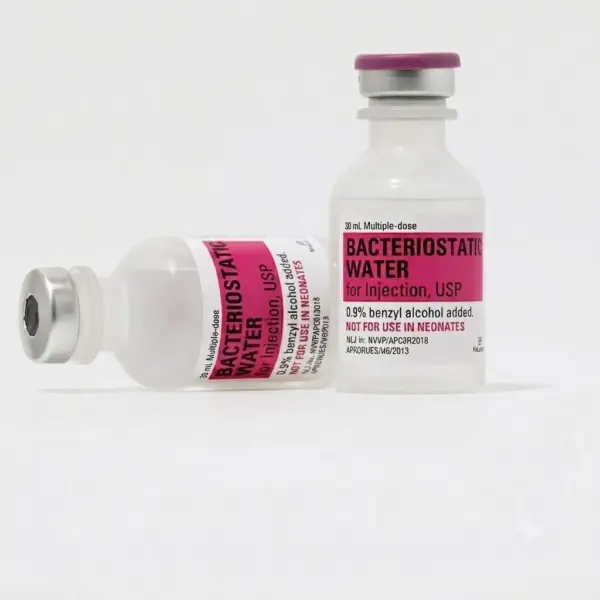
Bacteriostatic Water/Solution is a sterile aqueous solution containing a small amount of benzyl alcohol as a preservative. Bacteriostatic solutions are designed for specific controlled laboratory applications where a preserved sterile aqueous medium is required.
Unlike ordinary sterile water, a bacteriostatic formulation contains an antimicrobial preservative. The presence of benzyl alcohol helps inhibit the growth of microorganisms under appropriate conditions, although it should not be interpreted as making the solution permanently sterile or suitable for every application.
For research laboratories, sterile aqueous solutions can be important components of controlled experimental workflows involving laboratory materials, analytical procedures, and research compounds.
The exact formulation, concentration, container specifications, sterility testing, storage requirements, and intended applications should always be verified against the product-specific documentation and Certificate of Analysis (COA).
FOR RESEARCH USE ONLY. NOT FOR HUMAN OR VETERINARY USE.
Bacteriostatic water is a sterile water-based solution containing a preservative intended to inhibit microbial growth.
The term "bacteriostatic" describes the ability of the formulation to inhibit the multiplication of bacteria under appropriate conditions. It does not mean that the solution can eliminate all microorganisms or that contamination is impossible.
The most commonly recognized preservative used in bacteriostatic water formulations is benzyl alcohol.
For research purposes, this type of solution may be used as a laboratory diluent or aqueous research material where the formulation is compatible with the specific experimental protocol.
Because different products can have different specifications, researchers should always review the manufacturer's documentation before incorporating any solution into an experiment.
A typical bacteriostatic water formulation consists primarily of:
The preservative concentration is an important specification and should be confirmed from the product's labeling and analytical documentation rather than assumed.
The formulation is intended to provide an aqueous environment with antimicrobial preservative properties.
For laboratory research, important quality parameters may include:
Researchers should use the batch-specific COA to verify the characteristics of the material supplied.
Benzyl alcohol is an aromatic alcohol used in various pharmaceutical, laboratory, cosmetic, and chemical formulations.
In bacteriostatic water, its primary purpose is to act as a preservative.
The preservative helps reduce the likelihood of microbial proliferation when the formulation is handled according to its intended specifications.
However, the presence of a preservative does not eliminate the need for appropriate laboratory handling.
Researchers should still maintain appropriate controls for:
Although the terms are sometimes used interchangeably in informal discussions, bacteriostatic water and sterile water are not necessarily the same formulation.
The primary distinction is the presence of a preservative.
Generally contains:
May contain:
The appropriate choice depends entirely on the requirements of the specific laboratory procedure.
Researchers should never substitute one formulation for another without confirming compatibility with their approved protocol.
Bacteriostatic solutions may have applications in controlled laboratory environments where a sterile preserved aqueous medium is appropriate.
Potential research applications can include:
The exact application should always be determined by qualified research personnel and the applicable experimental protocol.
In research environments, water quality can significantly affect experimental consistency.
A suitable aqueous medium may be required when researchers are preparing controlled solutions or performing analytical procedures.
Using a standardized research solution can help laboratories maintain consistency between experiments.
Important considerations include:
Researchers should document the material used in experimental procedures so that results can be reproduced and evaluated accurately.
Sterility is particularly important when a solution is designated for sterile laboratory applications.
Quality-control documentation may include testing or specifications relating to:
A Certificate of Analysis provides batch-specific information and is generally more useful for laboratory records than generic product specifications.
For research organizations operating under documented quality systems, maintaining lot-specific records can also support experimental traceability.
The COA associated with a specific batch should be reviewed before laboratory use.
Depending on the manufacturer's testing program, documentation may include:
Researchers should retain the appropriate documentation according to their laboratory's recordkeeping requirements.
Storage requirements should always follow the product-specific manufacturer's instructions.
General laboratory considerations include protecting the container from:
The container should remain properly sealed when not in use.
Researchers should also inspect the solution before use for unexpected changes in:
If a product does not meet the expected specifications, it should be handled according to the laboratory's established quality procedures.
A bacteriostatic formulation is not a replacement for good laboratory practices.
Researchers should use appropriate procedures to reduce the possibility of contamination.
These may include:
Maintaining consistent handling procedures can help improve reproducibility across laboratory experiments.
Aqueous research solutions may be used in experimental workflows involving different types of research materials.
However, compatibility should never be assumed.
Researchers should evaluate:
Different compounds can behave differently in aqueous environments.
For that reason, laboratory personnel should follow the validated procedure or manufacturer's research documentation for the specific material being studied.
pH can influence the behavior and stability of dissolved compounds.
Depending on the research application, researchers may need to consider:
The pH specification for a particular product should be taken from its current batch documentation rather than assumed from the generic term "bacteriostatic water."
Water used in laboratory research can vary considerably in purity.
Depending on the application, laboratories may work with:
The appropriate water type depends on the experimental requirements.
For sensitive analytical procedures, researchers should use water meeting the relevant laboratory or analytical specification.
A preserved sterile solution can be useful when researchers require an aqueous laboratory material with antimicrobial preservative properties.
Potential research environments include:
The product should be used only within applications for which the formulation has been appropriately evaluated.
Researchers should consult the product's applicable Safety Data Sheet (SDS) and technical documentation before handling the material.
Appropriate laboratory procedures may include:
The preservative component should also be considered when evaluating chemical handling requirements.
It is a sterile aqueous solution containing an antimicrobial preservative, commonly benzyl alcohol, designed to inhibit microbial growth under appropriate conditions.
The primary difference is that bacteriostatic formulations contain an antimicrobial preservative, while sterile water formulations may not.
Benzyl alcohol is an aromatic alcohol used as a preservative and solvent in various formulations. In bacteriostatic water, it helps inhibit microbial growth.
No. The term bacteriostatic refers to inhibition of bacterial growth under appropriate conditions. It should not be interpreted as a guarantee against contamination or as a sterilizing agent.
Storage should follow the manufacturer's specific instructions. Researchers should pay attention to temperature, light exposure, container integrity, and contamination control.
Researchers should review information such as lot number, product identity, sterility specifications, appearance, pH, preservative concentration, and other applicable analytical results.
No. Compatibility depends on the individual compound and experimental procedure. Researchers should verify compatibility before use.
No. This product is intended for research use only and is not intended for human or veterinary use.
For laboratory education and scientific background, you can link this product page to authoritative resources such as:
U.S. Pharmacopeia – Official Standards
FDA – Drug Development and Manufacturing Information
These external resources provide useful background on pharmaceutical quality, laboratory practices, and regulated manufacturing environments.
For your own website, add internal links to:
You can also link to relevant Storage & Handling, Quality Testing, and Laboratory Education pages if those pages exist on your website.
Researchers looking for additional laboratory materials can explore the LabRat Peptides Research Collection.
For educational information about research materials, analytical testing, storage, and laboratory practices, visit the LabRat Peptides Research Hub.
FOR RESEARCH USE ONLY. NOT FOR HUMAN OR VETERINARY USE.
Bacteriostatic Water/Solution is presented as a laboratory research material. Information on this page is provided for scientific and educational purposes and should not be interpreted as medical advice, treatment guidance, or instructions for administration to humans or animals.
Researchers are responsible for ensuring that all materials are handled according to applicable regulations, institutional requirements, manufacturer documentation, and approved laboratory protocols.
| Sequence | Available on COA |
| Appearance | White Lyophilized Powder |
| Mol. Weight | 1419.6 g/mol |
| Purity | 99.2% |
| Storage | -20°C or below |
| SKU | BCT-WTR-51M |

All peptides and research chemicals sold on this site are intended exclusively for in-vitro laboratory research. They are not approved for human consumption, medical treatment, veterinary use, or any in-vivo application.