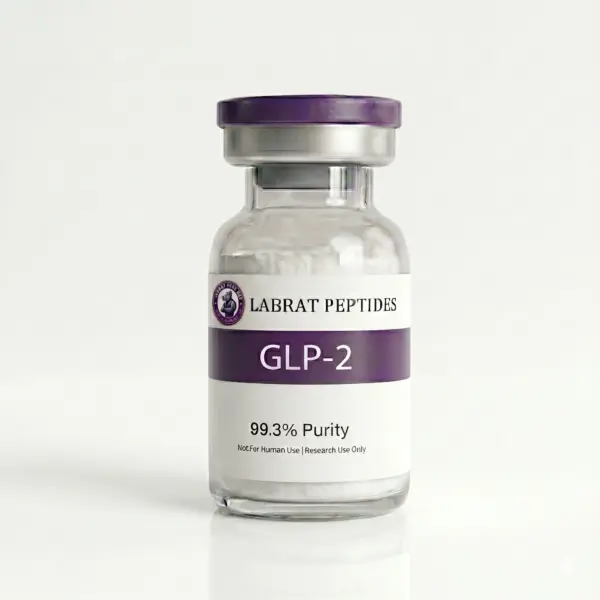
FOR RESEARCH SCIENTIFIC STUDIES ONLY- NOT FOR HUMAN/ANIMAL CONSUMPTION/USE
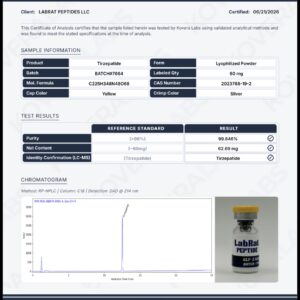
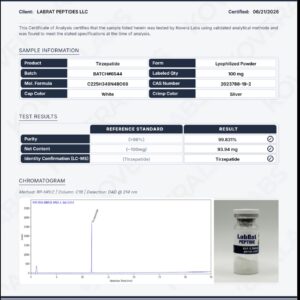
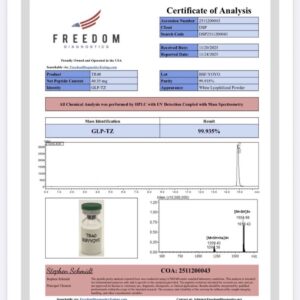
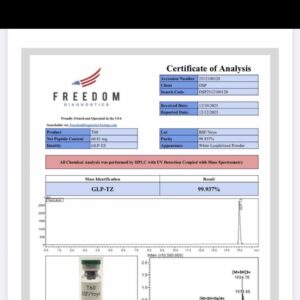
Every batch of Labrat Peptides undergoes third-party Mass Spectrometry and HPLC analysis. We believe in absolute transparency - since in third-party marketing we need complete confidence.
GLP-2 Tirze is a research-market designation associated with a synthetic peptide material intended for controlled laboratory investigation of GLP-1 and GIP receptor signaling, peptide pharmacology, GPCR pathways, cAMP activity, cellular signaling, and metabolic research.
Research involving tirzepatide-related peptide systems has generated significant scientific interest because of the interaction between two important class B G-protein-coupled receptors: the GLP-1 receptor (GLP-1R) and the glucose-dependent insulinotropic polypeptide receptor (GIPR).
This dual-receptor signaling profile provides researchers with an experimental framework for studying how simultaneous receptor activation influences intracellular signaling compared with single-receptor systems.
Laboratory investigations may examine receptor binding, receptor activation, cAMP production, protein phosphorylation, receptor trafficking, gene expression, peptide stability, and structure-activity relationships.
For published scientific literature, researchers can consult the [PubMed database for tirzepatide research]PubMed – Tirzepatide Research.
FOR RESEARCH USE ONLY. NOT FOR HUMAN OR VETERINARY USE.
The terminology surrounding GLP-related research compounds can sometimes be confusing.
GLP-2 Tirze should be regarded as a product or research-market designation rather than assuming that the name itself establishes the precise molecular identity of the material.
This is particularly important because GLP-2 is also the established name of glucagon-like peptide-2, a naturally occurring peptide hormone that is biologically distinct from GLP-1.
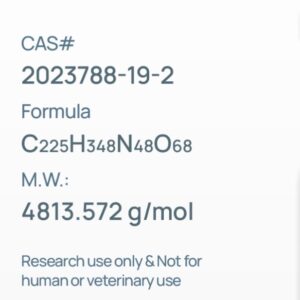
For this reason, researchers should rely on the product's:
when determining the identity and characteristics of a particular research material.
For scientific background on peptide and molecular research, the [National Center for Biotechnology Information]National Center for Biotechnology Information provides access to extensive biological databases and scientific resources.
The GLP-1 receptor is a class B G-protein-coupled receptor that has been extensively studied in molecular biology, cellular signaling, and receptor pharmacology.
Researchers can investigate the receptor using recombinant systems and appropriately validated cell-based assays.
Common experimental endpoints include:
The GLP-1 receptor is particularly useful for studying how peptide ligands interact with class B GPCRs.
Researchers can review published scientific literature through the [PubMed GLP-1 receptor research database]PubMed – GLP-1 Receptor Research.
The glucose-dependent insulinotropic polypeptide receptor, commonly abbreviated as GIPR, is another member of the class B GPCR family.
Research involving GIPR can investigate:
Studying GIPR alongside GLP-1R provides an opportunity to investigate multi-receptor pharmacology.
Researchers interested in the published literature can explore the [PubMed GIP receptor research database]PubMed – GIP Receptor Research.
One of the most interesting aspects of tirzepatide-related research is the study of dual-receptor pharmacology.
A single-target agonist primarily investigates one receptor system.
A dual-receptor research model allows scientists to examine two receptor pathways within the same experimental framework.
This can help researchers compare:
These experiments can contribute to a broader understanding of multi-receptor signaling.
G-protein-coupled receptors represent one of the largest families of membrane receptors in biology.
Class B GPCR research can involve:
GLP-1R and GIPR provide useful experimental systems for studying these mechanisms.
Researchers can explore broader scientific literature through [PubMed's GPCR signaling research database]PubMed – GPCR Signaling Research.
Cyclic adenosine monophosphate, or cAMP, is an important intracellular second messenger.
Activation of class B GPCRs can influence intracellular cAMP levels through G-protein-mediated signaling.
Researchers can use cAMP measurements to investigate receptor activity under controlled laboratory conditions.
Common approaches include:
Changes in cAMP can provide quantitative information about receptor-associated signaling.
Peptide pharmacology examines how peptide molecules interact with receptors and influence biological pathways.
Research may focus on:
Investigating the strength and characteristics of ligand-receptor interactions.
Comparing activity across different receptor systems.
Measuring cellular responses following receptor engagement.
Examining how environmental conditions influence peptide integrity.
Determining how molecular characteristics affect receptor interactions.
These studies can provide valuable information about peptide structure and biological signaling.
Structure-activity relationship studies examine how molecular changes influence biological activity.
Researchers may investigate:
Comparing related structures can help researchers identify molecular characteristics associated with receptor behavior.
This type of work is particularly relevant to peptide discovery and receptor pharmacology.
Receptor-binding experiments investigate the interaction between a peptide ligand and a receptor.
Depending on the research system, laboratories may use:
Researchers can compare the interaction of experimental compounds with GLP-1R and GIPR.
Binding experiments can be combined with functional assays to distinguish receptor interaction from downstream cellular activity.
Receptor activation can be investigated using functional cellular assays.
Potential endpoints include:
The resulting data can help researchers characterize how an experimental peptide influences receptor-associated signaling.
Experimental outcomes should always be interpreted according to the specific assay, cell model, receptor expression level, and research conditions.
GPCRs can undergo internalization following ligand interaction.
Researchers can study:
Fluorescence microscopy, tagged-receptor systems, and biochemical assays can be used to investigate these processes.
Understanding receptor trafficking can provide additional information beyond simple receptor activation measurements.
Activation of GLP-1R and GIPR can influence multiple intracellular pathways.
Researchers may investigate:
The exact signaling response depends on factors such as receptor expression, cell type, ligand characteristics, assay conditions, and experimental design.
GLP-1 and GIP receptor signaling is an important area of experimental metabolic research.
Laboratory studies may investigate:
These investigations can be conducted using appropriate cellular, biochemical, and preclinical models.
Research findings should remain within the context of the experimental system and should not automatically be interpreted as clinical outcomes.
Molecular biology techniques can be used to investigate changes in gene expression following experimental receptor activation.
Researchers may use:
Potential areas of investigation include genes associated with:
Appropriate controls and biological replication are important when evaluating gene-expression results.
Protein-level analysis can complement gene-expression measurements.
Researchers may examine:
Common analytical methods include:
Combining protein and gene-expression measurements can provide a broader picture of cellular responses.
Peptide stability is an important consideration in laboratory research.
Factors that can influence peptide integrity include:
Researchers can use analytical methods to monitor changes over time.
Stability studies may involve repeated testing under controlled conditions to determine whether measurable changes occur in the material.
Analytical characterization is essential for research peptide quality assessment.
Common techniques include:
High-performance liquid chromatography can provide information about chromatographic purity and sample composition.
Liquid chromatography-mass spectrometry combines chromatographic separation with mass-based analysis.
Mass spectrometry can assist with molecular-weight and identity characterization.
Peptide mapping can provide additional information about molecular characteristics and potential degradation.
Where available, researchers should review the batch-specific Certificate of Analysis associated with their material.
HPLC is widely used in peptide research.
Researchers may examine:
Analytical results should be interpreted according to the specific HPLC method, reference standard, and testing laboratory.
A purity percentage should therefore be associated with the relevant batch rather than assumed to apply universally to every production lot.
Mass spectrometry provides molecular-mass information that can complement HPLC.
Potential applications include:
Using multiple analytical approaches can provide a more comprehensive characterization profile.
A Certificate of Analysis (COA) can provide batch-specific information including:
For your WooCommerce product page, I recommend adding a link to the actual COA for the current lot if you have one available.
This provides better traceability and gives laboratory customers access to relevant quality documentation.
Different models can be used depending on the scientific question.
Potential systems include:
Each model has specific advantages and limitations.
Results obtained from one model should not automatically be generalized to another biological system.
A general laboratory workflow may follow:
Material Selection → Analytical Verification → Experimental Model → Controlled Experiment → Sample Collection → Molecular Analysis → Data Evaluation → Documentation
The exact methodology should be established by qualified researchers according to their laboratory's approved protocol.
Research peptides should be stored and handled according to current product documentation and appropriate laboratory procedures.
Researchers should consider:
Appropriate storage conditions can help preserve material integrity.
Laboratory personnel should consult the applicable product documentation and SDS before handling research materials.
Research materials should be handled by appropriately trained laboratory personnel.
Standard laboratory practices may include:
All laboratory research should follow applicable institutional, regulatory, and safety requirements.
Researchers interested in related laboratory materials can explore the [Research Peptides collection]LabRat Peptides Research Peptides.
For compounds associated with metabolic pathway research, visit the [Metabolic Peptides category]LabRat Peptides Metabolic Peptides.
Additional educational information covering peptide biology, laboratory methods, and scientific research is available through the [Peptide Research section]LabRat Peptides Research Blog.
Researchers can also explore other [Research Compounds]LabRat Peptides Research Collection available for laboratory investigation.
For additional scientific literature and educational resources, researchers can consult:
When implementing these in WordPress, make sure the external links are standard DoFollow links and that you do not add rel="nofollow" to them.
GLP-2 Tirze is a research-market designation associated with a tirzepatide-related research material and experimental investigation of GLP-1 and GIP receptor signaling.
The principal receptor systems associated with tirzepatide research are the GLP-1 receptor and GIP receptor.
A dual-receptor agonist is a molecule designed to interact with two receptor systems, allowing researchers to investigate combined signaling pathways.
GPCR signaling describes the cellular communication processes initiated when a G-protein-coupled receptor interacts with an appropriate ligand.
cAMP is an intracellular second messenger and can be used as a measurable endpoint in functional receptor assays.
HPLC, LC-MS, mass spectrometry, and other validated analytical methods can be used for research peptide characterization.
No. This product is intended strictly for laboratory research and is not intended for human or veterinary use.
FOR RESEARCH USE ONLY. NOT FOR HUMAN OR VETERINARY USE.
This product is presented for controlled laboratory research. The information provided is intended for scientific and educational purposes only and does not constitute medical advice, treatment recommendations, dosing instructions, or instructions for human or veterinary administration.
The designation GLP-2 Tirze should be interpreted according to the specific product documentation and analytical characterization supplied for the material. The terminology should not be used as a substitute for molecular identification.
Research results can vary according to the experimental model, material preparation, analytical methodology, assay conditions, and laboratory protocol.
Researchers are responsible for complying with applicable laws, institutional requirements, laboratory safety procedures, manufacturer documentation, and approved research protocols.
| Sequence | Available on COA |
| Appearance | White Lyophilized Powder |
| Mol. Weight | 1419.6 g/mol |
| Purity | 99.2% |
| Storage | -20°C or below |
| SKU | 9954267463966-big-gs-1 |

All peptides and research chemicals sold on this site are intended exclusively for in-vitro laboratory research. They are not approved for human consumption, medical treatment, veterinary use, or any in-vivo application.