FOR RESEARCH SCIENTIFIC STUDIES ONLY- NOT FOR HUMAN/ANIMAL CONSUMPTION/USE
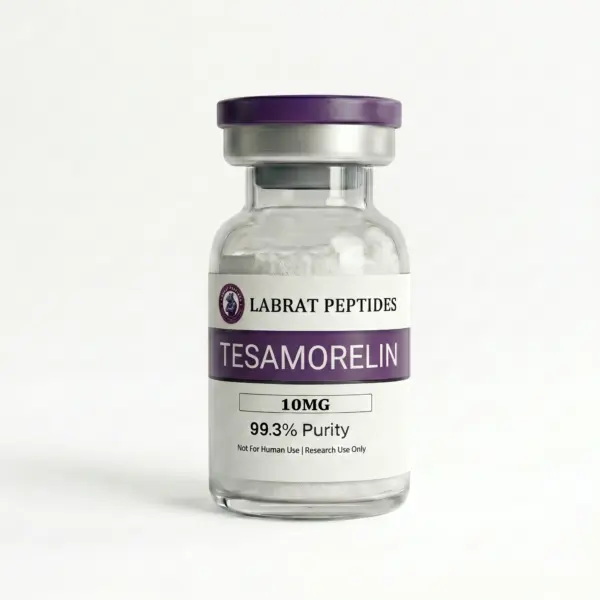
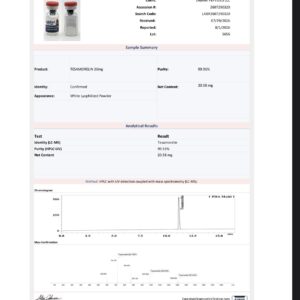
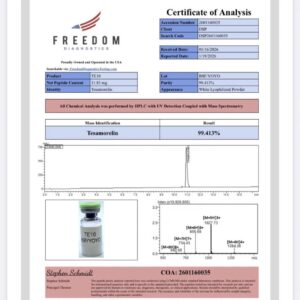
Every batch of Labrat Peptides undergoes third-party Mass Spectrometry and HPLC analysis. We believe in absolute transparency - since in third-party marketing we need complete confidence.
Tesamorelin 10/20MG is a synthetic peptide research material supplied for controlled laboratory investigation, analytical testing, biochemical research, peptide characterization, and scientific study.
Tesamorelin is a stabilized synthetic analog of growth hormone-releasing hormone (GHRH), also referred to as growth hormone-releasing factor (GHRF). Research on tesamorelin has examined its effects on growth-hormone-related signaling, insulin-like growth factor-1 (IGF-1), body composition, visceral adipose tissue, and metabolic biology. PubChem
The compound is particularly relevant to researchers studying the GHRH–growth hormone–IGF-1 axis and the biological mechanisms associated with growth hormone secretion.
Tesamorelin has also been investigated extensively in clinical research. The FDA-approved pharmaceutical formulation has a specific indication for reducing excess abdominal fat in HIV-infected adults with lipodystrophy, and the FDA labeling specifically states that it is not indicated for weight-loss management. FDA Access Data
The Tesamorelin 10/20MG research material offered by LabRat Peptides is intended strictly for Research Use Only (RUO).
It is not intended for human consumption, self-administration, therapeutic use, clinical treatment, diagnosis, disease prevention, veterinary use, or food applications.
Researchers can explore additional Research Peptides and scientific information through the LabRat Peptides Research Hub.
Tesamorelin is a synthetic peptide analog of growth hormone-releasing hormone (GHRH).
GHRH is a hypothalamic signaling peptide involved in regulation of growth hormone secretion by the pituitary gland. Tesamorelin was developed as a stabilized analog capable of interacting with the GHRH receptor and stimulating the physiological growth-hormone signaling pathway.
The parent tesamorelin molecule is listed in PubChem under CAS 218949-48-5, with the molecular formula C221H366N72O67S and molecular weight of approximately 5136 g/mol. PubChem
Tesamorelin is therefore fundamentally different from peptides such as semaglutide, tirzepatide, or survodutide.
While those compounds are investigated primarily in the GLP-1/glucagon receptor research area, tesamorelin belongs to the GHRH/GH research category.
This makes Tesamorelin 10/20MG particularly relevant for researchers investigating:
| Specification | Information |
|---|---|
| Product Name | Tesamorelin 10/20MG |
| Compound | Tesamorelin |
| Alternative Name | TH9507 |
| CAS Number | 218949-48-5 |
| Molecular Formula | C221H366N72O67S |
| Molecular Weight | Approximately 5136 g/mol |
| Peptide Type | Synthetic GHRH/GHRF analog |
| Primary Research Area | GHRH / Growth Hormone Signaling |
| Available Research Quantity | 10MG / 20MG |
| Classification | Research Use Only |
PubChem reports the tesamorelin sequence as:
YADAIFTNSYRKVLGQLSARKLLQDIMSRQQGESNQERGARARL PubChem
Tesamorelin and tesamorelin acetate should not be treated as chemically identical for specification purposes.
PubChem separately identifies tesamorelin acetate with the molecular formula C223H370N72O69S and molecular weight of approximately 5196 g/mol. PubChem
Therefore, your product page should use the exact chemical form stated on your batch COA.
One of the most important areas of tesamorelin research involves the growth hormone-releasing hormone receptor.
GHRH is involved in signaling between the hypothalamus and pituitary gland. Activation of the GHRH receptor can stimulate growth hormone secretion, which subsequently influences downstream biological pathways involving IGF-1 and other metabolic processes.
Tesamorelin is designed to function as a GHRH analog and has therefore become an important research compound for studying this signaling pathway.
Researchers investigating Tesamorelin may examine:
For additional scientific literature, researchers can use PubMed – Tesamorelin Research.
The GHRH–GH–IGF-1 axis is an important biological signaling system.
GHRH signaling can stimulate the secretion of growth hormone from the anterior pituitary. Growth hormone then participates in downstream physiological processes, including stimulation of IGF-1 production.
Tesamorelin has been investigated as a synthetic GHRH analog capable of interacting with this pathway.
For researchers, this makes Tesamorelin 10/20MG useful as a model compound for investigating:
Research should be conducted using appropriate experimental models and validated laboratory methods.
IGF-1, or insulin-like growth factor-1, is an important downstream component of growth hormone signaling.
Research involving tesamorelin has demonstrated changes in IGF-1 in experimental and clinical research settings.
For example, a randomized controlled study of tesamorelin in abdominally obese subjects with reduced growth hormone secretion reported an increase in IGF-1 alongside reductions in visceral adipose tissue. PubMed
This makes tesamorelin relevant to research involving:
The observed effects in clinical or animal research should not be interpreted as evidence that a research product is suitable for human use.
Tesamorelin has been extensively investigated in relation to visceral adipose tissue (VAT).
In a randomized clinical study involving HIV-infected patients with abdominal fat accumulation, tesamorelin was associated with a reduction in visceral adipose tissue compared with placebo. PubMed
An earlier randomized clinical study published in the New England Journal of Medicine also investigated tesamorelin in patients with HIV-associated abdominal fat accumulation and reported reductions in visceral adipose tissue. New England Journal of Medicine
These studies provide scientific context for researchers investigating the relationship between:
However, the results of clinical trials should not be interpreted as a recommendation to use laboratory research material in humans.
Tesamorelin has also been studied in metabolic research models.
A randomized controlled trial in abdominally obese subjects with reduced growth hormone secretion investigated tesamorelin over 12 months. Researchers observed reductions in visceral adipose tissue and changes in several metabolic research endpoints. PubMed
Such research provides opportunities for investigating relationships between growth hormone signaling and metabolic biology.
Laboratory research involving tesamorelin may examine:
Researchers should evaluate each experimental finding within the specific study design and biological model in which it was generated.
Tesamorelin 10/20MG can be relevant to several areas of scientific investigation.
Tesamorelin can be studied as a synthetic GHRH analog in research involving receptor activation and downstream signaling.
Researchers can investigate the relationship between GHRH signaling and growth hormone secretion.
Tesamorelin provides a model compound for studying downstream IGF-1-related signaling.
The molecule can be investigated for peptide-receptor interactions, pharmacological characteristics, and molecular behavior.
Tesamorelin has been investigated in research involving visceral adipose tissue and metabolic parameters.
Researchers can evaluate peptide identity, purity, molecular mass, and other analytical characteristics using validated laboratory techniques.
Peptide characterization is an important component of research-quality assessment.
Tesamorelin is a relatively large peptide molecule with a reported molecular weight of approximately 5136 g/mol for the parent compound. PubChem
Laboratories may use analytical techniques such as:
The appropriate analytical method depends on the research objective and laboratory methodology.
For commercial research materials, the batch-specific Certificate of Analysis should be used to verify the exact product specifications.
Researchers should review quality documentation before incorporating research peptides into laboratory workflows.
Depending on the testing program, a Tesamorelin COA may include:
The COA should correspond to the exact batch of Tesamorelin 10/20MG being evaluated.
Avoid relying on generic purity claims when batch-specific analytical documentation is available.
Researchers looking for additional laboratory materials can browse the LabRat Peptides Research Peptides Collection.
A Certificate of Analysis (COA) is an important document for research-material traceability.
For Tesamorelin 10/20MG, the COA may document the analytical identity and quality characteristics of the supplied batch.
Researchers should verify:
Maintaining the COA alongside the research material can help laboratories maintain accurate research records.
Tesamorelin 10/20MG should be stored according to the specific product documentation and batch-specific COA.
For lyophilized peptide research materials, laboratories should pay attention to:
Researchers should avoid unnecessary exposure of peptide materials to environmental conditions and follow the storage requirements supplied with the specific product.
For general educational information, visit the LabRat Peptides Research Hub.
You can also read Understanding Lyophilized Research Materials for additional laboratory information.
Tesamorelin should be handled by appropriately trained laboratory personnel.
Research institutions should establish appropriate procedures for:
Researchers are responsible for ensuring that their use of laboratory materials complies with applicable regulations and institutional requirements.
Tesamorelin has been studied extensively in human clinical research.
The FDA-approved drug formulation is indicated for reduction of excess abdominal fat in HIV-infected adults with lipodystrophy. The FDA labeling specifically states that it is not indicated for weight-loss management. FDA Access Data
The FDA label also identifies tesamorelin as a growth hormone-releasing factor analog and provides formulation-specific information for the approved pharmaceutical product. FDA Access Data
This distinction is important for research-product pages:
Tesamorelin research material ≠ an approved pharmaceutical product.
LabRat Peptides' Tesamorelin 10/20MG should therefore be described as Research Use Only, rather than as a treatment or medication.
Tesamorelin has been investigated in multiple clinical and scientific studies.
A randomized clinical study investigated tesamorelin in HIV-infected patients with abdominal fat accumulation and reported reductions in visceral adipose tissue. PubMed
Researchers can review the publication through PubMed – Tesamorelin Clinical Research.
A randomized controlled study investigated tesamorelin in abdominally obese subjects with reduced growth hormone secretion and examined visceral adipose tissue, metabolic parameters, and IGF-1. PubMed
Read the study through PubMed – Tesamorelin Metabolic Research.
Research published in the New England Journal of Medicine investigated tesamorelin in patients with HIV and abdominal fat accumulation. New England Journal of Medicine
Researchers can access the publication through NEJM – Metabolic Effects of a Growth Hormone-Releasing Factor.
Researchers can review molecular information through PubChem – Tesamorelin.
FOR RESEARCH USE ONLY. NOT FOR HUMAN OR VETERINARY USE.
Tesamorelin 10/20MG is supplied as laboratory research material for scientific investigation, analytical testing, peptide characterization, biochemical research, and related laboratory applications.
This product is not intended for:
Scientific literature referenced on this page is provided for research and educational context and should not be interpreted as a recommendation for human use.
Tesamorelin is a synthetic analog of growth hormone-releasing hormone (GHRH), also known as growth hormone-releasing factor (GHRF). PubChem
Tesamorelin 10/20MG is a research-material presentation supplied for laboratory investigation, peptide research, analytical testing, and biochemical studies.
Tesamorelin research includes GHRH signaling, growth hormone pathways, IGF-1 signaling, visceral adipose tissue, metabolic biology, peptide pharmacology, and analytical peptide characterization.
No. Tesamorelin is a GHRH/GHRF analog and belongs to a different research category from GLP-1 receptor agonists such as semaglutide. PubChem
PubChem lists the parent tesamorelin molecular weight at approximately 5136 g/mol. PubChem
The parent tesamorelin molecular formula is C221H366N72O67S. PubChem
Tesamorelin acetate is a distinct chemical form containing tesamorelin associated with acetate. PubChem lists its molecular weight at approximately 5196 g/mol. PubChem
Yes. Tesamorelin has undergone extensive clinical investigation, including studies involving HIV-associated lipodystrophy and metabolic research. New England Journal of Medicine
The FDA labeling for EGRIFTA SV specifically states that it is not indicated for weight-loss management. FDA Access Data
No. LabRat Peptides' research material is supplied strictly for Research Use Only and is not intended for human or veterinary use.
Researchers can search PubMed for Tesamorelin or review molecular information through PubChem.
Explore the LabRat Peptides Research Peptide Collection for additional laboratory research materials.
Researchers interested in Tesamorelin research, GHRH peptides, growth hormone signaling, IGF-1 research, peptide pharmacology, metabolic research, visceral adipose tissue research, and analytical peptide testing can explore the LabRat Peptides Research Peptide Collection.
For scientific and educational information, visit the LabRat Peptides Research Hub.
For general information about handling lyophilized research materials, read Understanding Lyophilized Research Materials.
FOR RESEARCH USE ONLY. NOT FOR HUMAN OR VETERINARY USE.
Tesamorelin 10/20MG is supplied as laboratory research material for scientific investigation, analytical testing, peptide characterization, and biochemical research.
The information presented on this page is intended for scientific and educational purposes. Published clinical research does not establish that a laboratory research material is appropriate for human use.
Researchers are responsible for ensuring that research materials are used in accordance with applicable laws, regulations, institutional policies, laboratory procedures, and approved research protocols.
| Sequence | Available on COA |
| Appearance | White Lyophilized Powder |
| Mol. Weight | 1419.6 g/mol |
| Purity | 99.2% |
| Storage | -20°C or below |
| SKU | TSM |

All peptides and research chemicals sold on this site are intended exclusively for in-vitro laboratory research. They are not approved for human consumption, medical treatment, veterinary use, or any in-vivo application.