FOR RESEARCH SCIENTIFIC STUDIES ONLY
Every batch of Labrat Peptides undergoes third-party Mass Spectrometry and HPLC analysis. We believe in absolute transparency - since in third-party marketing we need complete confidence.
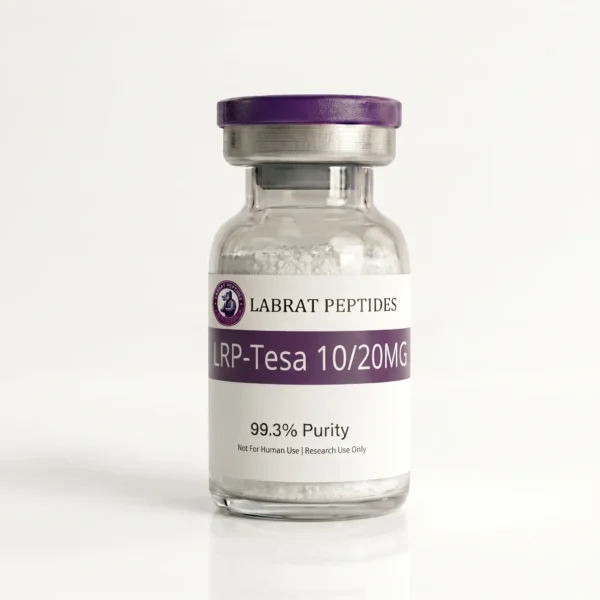
LRP-Tesa 10/20MG is a synthetic peptide research material supplied for controlled laboratory investigation, analytical testing, peptide characterization, biochemical studies, molecular research, and scientific analysis.
The material is provided for Research Use Only (RUO) applications within appropriately equipped laboratory environments. Qualified researchers can investigate its analytical characteristics, molecular properties, sample behavior, and related research parameters according to their laboratory methods and approved research procedures.
Researchers looking for additional laboratory materials can explore the Research Peptides Collection.
Additional educational information and laboratory resources are available through the LabRat Peptides Research Hub.
LRP-Tesa 10/20MG is a synthetic peptide research material intended for controlled scientific investigation.
Laboratory research involving this type of material can focus on peptide characterization, molecular interactions, analytical properties, receptor-related research, cellular signaling studies, biochemical investigation, and related areas of molecular science.
The exact research application depends on the experimental model, laboratory equipment, research objective, and analytical methodology selected by the researcher.
Potential research areas include:
These categories describe potential areas of scientific investigation and should not be interpreted as instructions for a specific experimental procedure.
Researchers should select appropriate methods based on their scientific objectives and laboratory capabilities.
Product specifications should always be confirmed using the applicable batch-specific Certificate of Analysis (COA) and current product documentation.
| Specification | Information |
|---|---|
| Product Name | LRP-Tesa 10/20MG |
| Product Type | Synthetic peptide research material |
| Research Category | Peptide research |
| Available Quantity | 10MG / 20MG |
| Classification | Research Use Only |
| Documentation | Batch-specific COA |
Batch-specific documentation should take precedence over general product-page information when researchers are evaluating a particular material.
A product description provides general information, while a Certificate of Analysis provides batch-level analytical information associated with the specific material being evaluated.
Peptides are frequently examined in laboratory science because their defined molecular structures allow researchers to investigate specific analytical and biochemical characteristics.
Research involving LRP-Tesa 10/20MG may include controlled examination of peptide structure, molecular interactions, analytical response, and related signaling mechanisms.
Laboratory investigations can be designed around specific scientific questions. Depending on the research objective, investigators may evaluate the material using chromatographic methods, mass-based analytical techniques, molecular characterization, or other appropriate laboratory procedures.
Researchers should consider the limitations of each analytical method when interpreting results. Findings obtained using one method may provide only one part of a broader characterization profile.
For additional scientific literature, researchers can explore PubMed and the National Center for Biotechnology Information.
Peptide characterization involves the analytical examination of a research material to establish information about its identity, purity, molecular characteristics, and other measurable properties.
Laboratories may use one or more analytical methods depending on their research requirements.
Potential methods include:
The selected method should be appropriate for the material and the research question being investigated.
Analytical conditions can influence the resulting data. Researchers should therefore document relevant variables such as sample preparation, instrument configuration, analytical conditions, reference materials, and testing procedures.
High-performance liquid chromatography, commonly referred to as HPLC, is an analytical technique used to separate and examine components within a sample.
Researchers may use chromatographic methods to investigate the analytical profile of peptide materials.
Depending on the method, laboratory analysis may provide information concerning:
Chromatographic results should be interpreted according to the method used and the controls established for the experiment.
Researchers can review scientific information concerning chromatography through NCBI Bookshelf.
When a batch-specific analytical report is available, the reported results should be associated with the exact batch or lot being evaluated.
Mass-based analytical techniques can provide additional information when researchers are characterizing peptide materials.
Liquid chromatography combined with mass spectrometry can provide both separation and molecular-analysis information. Researchers may use such techniques when investigating sample composition or molecular characteristics.
The suitability of a particular analytical technique depends on:
Researchers should use established laboratory procedures and interpret results according to the limitations of the analytical method.
Additional scientific literature relating to peptide analysis can be located through PubMed's peptide research database.
Analytical purity is one of the characteristics that laboratories may evaluate when studying a research material.
Purity measurements should always be interpreted in relation to the analytical technique used. Different analytical procedures can provide different types of information, and a single reported value should not be treated as a complete description of every characteristic of a material.
Researchers should review the applicable COA when assessing batch-specific analytical information.
A COA may contain information such as:
The exact information depends on the applicable testing program and documentation.
The Certificate of Analysis (COA) is an important part of research-material documentation.
Researchers should confirm that the COA corresponds to the exact batch or lot under investigation.
Batch-specific documentation can assist laboratories with:
Researchers should retain appropriate product documentation as part of their laboratory records.
General information presented on a product page should not replace the applicable batch-specific analytical documentation.
Proper storage is an important consideration when maintaining peptide research materials.
LRP-Tesa 10/20MG should be stored according to the product-specific documentation and applicable batch information.
Relevant storage considerations may include:
Laboratories should establish appropriate storage procedures based on their own research environment and the documentation supplied with the material.
Researchers can review the Research Material Storage resource for additional educational information.
For information about freeze-dried research materials, researchers can also review Understanding Lyophilized Research Materials.
Storage requirements should always be determined from product-specific information rather than assumptions about peptide materials in general.
LRP-Tesa 10/20MG should be handled by appropriately trained laboratory personnel using suitable laboratory procedures.
Research institutions should maintain procedures covering:
Laboratories are responsible for establishing procedures suitable for their environment and complying with applicable institutional requirements and regulations.
Product information does not replace laboratory safety documentation, institutional procedures, or approved research protocols.
Traceability helps researchers maintain an organized record of laboratory materials throughout an experimental project.
When receiving LRP-Tesa 10/20MG, laboratories may record:
During subsequent research activities, the same identifiers can be maintained through sample preparation and analytical testing.
This approach helps connect experimental observations with the specific research material used in the study.
Molecular research can involve the investigation of interactions between defined molecules, receptors, signaling pathways, and cellular systems.
LRP-Tesa 10/20MG may be examined within controlled laboratory studies designed to investigate peptide-related molecular characteristics.
Depending on the research model, investigators may study:
The appropriate research model depends on the scientific question being investigated.
Results should be interpreted according to the experimental conditions, controls, methodology, and analytical techniques used.
Biochemical research examines molecular processes and interactions using controlled laboratory methods.
Research involving peptide materials can include analytical studies of molecular characteristics, sample composition, interactions, and related biochemical parameters.
Laboratories may select appropriate techniques according to the research objective.
Potential laboratory approaches can include:
Researchers should document their experimental conditions to support accurate interpretation and reproducibility.
Analytical chemistry provides methods for identifying and characterizing research materials.
For peptide research, analytical chemistry may involve evaluating:
The analytical method should be selected according to the material and research objective.
Researchers can consult established scientific resources such as NCBI and PubChem when gathering background information for laboratory research.
Research laboratories may also use defined materials when developing or evaluating analytical methods.
Method-development work can involve comparing analytical conditions and determining which procedures provide suitable separation, detection, identification, or characterization.
Researchers may examine variables such as:
Any method should be evaluated according to the requirements of the particular research project.
Batch comparison can be used to examine analytical consistency between different samples.
A laboratory may compare batches using the same analytical procedure and controlled sample-preparation process.
A typical comparison may involve:
Differences between analytical results should be evaluated carefully. Sample preparation, instrument performance, analytical conditions, and normal method variability can all affect observed results.
Researchers investigating peptide-related molecular science should consult established scientific literature and reference databases.
Useful resources include:
These resources can provide access to published research, molecular information, scientific references, and educational material.
Scientific literature should be evaluated according to the specific study design, experimental system, material evaluated, analytical method, and publication context.
Published findings should not automatically be generalized to every research material or laboratory model.
Researchers working with peptide characterization, analytical chemistry, molecular research, and biochemical investigation can explore the broader Research Peptides Collection.
Additional educational resources include the LabRat Peptides Research Hub.
Researchers can also review the Research Material Storage resource for general information about laboratory storage practices.
These internal resources provide additional context for laboratories organizing peptide research materials and related analytical workflows.
FOR RESEARCH USE ONLY.
LRP-Tesa 10/20MG is supplied as a laboratory research material for scientific investigation, analytical testing, peptide characterization, biochemical research, molecular research, and related laboratory applications.
This material is not intended for:
Researchers are responsible for ensuring that research materials are used according to applicable laws, regulations, institutional requirements, laboratory procedures, and approved research protocols.
LRP-Tesa 10/20MG is a synthetic peptide research material supplied for controlled laboratory investigation, analytical testing, peptide characterization, biochemical research, and molecular research.
Potential areas include peptide characterization, molecular research, biochemical investigation, analytical chemistry, receptor-related research, cellular signaling studies, and analytical method development.
Depending on the research objective, laboratories may use HPLC, reverse-phase chromatography, LC-MS, mass spectrometry, molecular-mass analysis, identity testing, purity analysis, and other suitable analytical procedures.
Researchers should review the applicable product documentation, batch-specific Certificate of Analysis, storage information, handling requirements, and laboratory procedures.
Storage should follow the product-specific documentation supplied with the material. Laboratories should consider temperature, moisture, light exposure, container integrity, storage duration, and other relevant environmental factors.
Researchers can explore the Research Peptides Collection for additional research materials.
Researchers can use PubMed, NCBI, and PubChem for scientific literature and molecular reference information.
Researchers interested in LRP-Tesa 10/20MG and related laboratory research topics can explore the Research Peptides Collection.
For storage-related information, visit Research Material Storage.
For educational information about freeze-dried research materials, visit Understanding Lyophilized Research Materials.
For scientific literature and reference information, researchers can consult PubMed, NCBI, and PubChem.
FOR RESEARCH USE ONLY.
The information presented on this page is intended for scientific and educational purposes.
Product information should be reviewed together with applicable batch documentation and the Certificate of Analysis.
Researchers are responsible for determining whether a research material is appropriate for their specific laboratory procedures and for complying with applicable laws, regulations, institutional requirements, safety procedures, and research protocols.
Scientific information should be interpreted according to the specific study, experimental model, methodology, formulation, and material evaluated.
| Sequence | Available on COA |
| Appearance | White Lyophilized Powder |
| Mol. Weight | 1419.6 g/mol |
| Purity | 99.2% |
| Storage | -20°C or below |
| SKU | LRP-Tesa |