

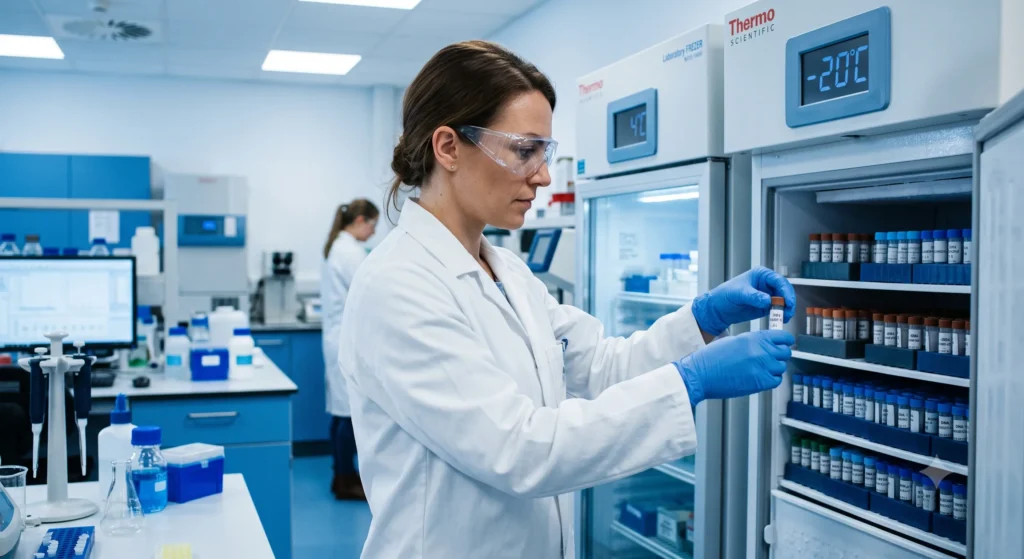
Research Material Storage: Temperature Considerations and Best Practices
Proper research material storage is an important part of maintaining the quality, stability, and integrity of laboratory samples. Peptides, proteins, enzymes, reagents, reference materials, and other laboratory compounds can have different environmental requirements, making appropriate storage conditions essential for reliable research workflows.
Temperature is one of the most important factors laboratories consider when establishing storage procedures. Depending on the material, exposure to excessive heat, freezing conditions, repeated temperature changes, moisture, or other environmental factors may affect its characteristics over time.
This guide explains common laboratory storage temperatures, temperature monitoring, freezer organization, transportation considerations, equipment maintenance, and other best practices for storing temperature-sensitive laboratory materials.
Important: Storage requirements vary significantly by material. Researchers should always follow the manufacturer's specifications, product documentation, institutional procedures, and applicable laboratory protocols.
Why Temperature Matters in Laboratory Storage
Temperature can influence the physical and chemical stability of many laboratory materials.
For some temperature-sensitive compounds, prolonged exposure to conditions outside the recommended range may contribute to degradation or changes in material characteristics. Appropriate storage practices are therefore an important component of laboratory quality management.
Effective storage procedures can help laboratories:
- Maintain sample integrity
- Reduce unnecessary environmental exposure
- Support consistent research workflows
- Improve inventory management
- Maintain traceability
- Support reproducible laboratory practices
Organizations such as the National Institutes of Health (NIH) provide extensive resources relating to laboratory research, biomedical science, and responsible research practices.
Common Laboratory Storage Temperature Ranges
Different materials require different storage environments. There is no universal temperature that is appropriate for every laboratory compound or research sample.
Common storage categories include:
- Controlled room temperature
- Refrigerated storage
- Frozen storage
- Ultra-low-temperature storage
The correct condition should always be determined from the specific product's documentation.
Controlled Room Temperature: 15°C–25°C
Some laboratory supplies and relatively stable materials may be maintained under controlled room-temperature conditions.
A controlled environment can be suitable for certain:
- Laboratory consumables
- Glassware
- Documentation
- Equipment supplies
- Stable reagents
- Materials specifically labeled for room-temperature storage
However, 15°C–25°C should not automatically be assumed to be suitable for every research material.
Researchers should verify the manufacturer's recommended conditions before placing a temperature-sensitive material into room-temperature storage.
Maintaining a stable laboratory environment is generally preferable to exposing materials to repeated changes in temperature.
Refrigerated Storage: 2°C–8°C
Refrigerated storage is commonly used for certain laboratory reagents, biological materials, prepared solutions, and analytical standards.
A laboratory refrigerator maintained within an appropriate range can help support the stability of materials that should not be frozen.
Examples may include:
- Selected research reagents
- Certain biological materials
- Prepared laboratory solutions
- Some analytical standards
- Quality-control materials
Laboratories should avoid storing research materials in household refrigerators where dedicated laboratory equipment is required.
Temperature should be monitored using appropriate instruments, such as calibrated thermometers or electronic data loggers.
Frozen Storage: -20°C
Many laboratories use -20°C freezers for materials that require frozen storage.
This environment is commonly encountered in research settings for various biological samples, reagents, and other temperature-sensitive materials.
Good freezer-management practices include:
- Clearly labeling every container
- Maintaining an accurate inventory
- Organizing materials by category
- Minimizing unnecessary door openings
- Monitoring freezer temperature
- Removing obsolete materials according to laboratory procedures
- Maintaining appropriate backup procedures
The appropriate temperature for a particular material should always come from the manufacturer's specifications rather than being assumed based solely on the fact that it is a research material.
Ultra-Low Temperature Storage: -80°C
Ultra-low-temperature freezers can provide storage environments around -80°C for materials requiring very low temperatures.
These systems are commonly found in research laboratories working with highly temperature-sensitive biological samples and research specimens.
Typical applications may include:
- Long-term biological sample preservation
- Research specimens
- Biological reference materials
- Specialized laboratory samples
- Materials requiring ultra-low-temperature conditions
Ultra-low-temperature equipment requires appropriate maintenance because equipment failure can result in significant sample loss.
The National Institute of Standards and Technology (NIST) provides scientific and measurement resources relevant to laboratory measurement and calibration practices.
Temperature-Sensitive Research Materials
Some laboratory materials are more sensitive to environmental changes than others.
Examples can include:
- Research peptides
- Proteins
- Enzymes
- Biological reagents
- Certain reference standards
- Specialized biochemical materials
For example, researchers working with research peptides should follow the specific storage information supplied with the material rather than applying a generic storage rule.
You can internally connect this section to your Research Peptides category to help visitors explore relevant laboratory research materials.
Similarly, your Amino Acids category can be linked where the article discusses specialized biochemical research materials.
Avoid Repeated Temperature Fluctuations
Temperature stability is an important consideration when organizing laboratory storage.
Repeated warming and cooling cycles may affect some temperature-sensitive materials. For this reason, researchers should minimize unnecessary exposure outside the recommended storage environment.
Good practices include:
- Plan sample retrieval before opening a freezer or refrigerator.
- Keep doors closed whenever possible.
- Return materials to storage promptly.
- Organize containers so samples can be located quickly.
- Avoid repeatedly moving materials between different storage environments.
- Maintain an organized inventory system.
Good organization can reduce the amount of time that storage equipment remains open and can make laboratory workflows more efficient.
Laboratory Temperature Monitoring
Monitoring storage conditions helps laboratories identify temperature deviations and potential equipment problems.
Depending on laboratory requirements, monitoring systems can include:
- Digital temperature displays
- Calibrated thermometers
- Temperature data loggers
- Continuous monitoring systems
- Automated alarm systems
- Manual temperature records
For critical materials, continuous monitoring can provide additional visibility into storage conditions.
Electronic monitoring systems can also generate records that help laboratories investigate temperature excursions.
The National Institute of Standards and Technology (NIST) provides resources concerning measurement science, calibration, and laboratory measurement practices.
What Is a Temperature Excursion?
A temperature excursion occurs when a stored material is exposed to temperatures outside its specified storage range.
For example, an excursion could occur if:
- A freezer temporarily stops operating.
- A refrigerator door remains open.
- A power failure affects storage equipment.
- A sample is accidentally left outside controlled storage.
- Equipment develops a temperature-control problem.
The appropriate response depends on the material and the duration and severity of the excursion.
Researchers should document the event and follow their laboratory's established deviation or incident procedures.
Do not automatically assume that an affected material is usable or unusable. The appropriate decision should be based on available stability information, manufacturer guidance, and applicable laboratory procedures.
Organizing Temperature-Sensitive Materials
Good organization is an important part of effective research sample storage.
Laboratories can improve organization by:
- Clearly labeling containers
- Recording lot or batch numbers
- Assigning storage locations
- Grouping similar materials
- Maintaining digital inventory records
- Using appropriate racks or storage boxes
- Keeping frequently accessed materials easy to locate
An organized freezer or refrigerator reduces the time required to locate samples and can help minimize unnecessary exposure to changing environmental conditions.
Research Material Storage and Inventory Management
Storage and inventory management work together.
An effective inventory system can help laboratories track:
- Material name
- Lot or batch number
- Quantity
- Date received
- Storage location
- Date opened
- Expiration or review date where applicable
- Storage requirements
- Relevant documentation
Laboratories may use spreadsheets, laboratory inventory software, or Laboratory Information Management Systems (LIMS) depending on the size and complexity of their operations.
The National Center for Biotechnology Information (NCBI) provides extensive scientific databases and resources used throughout biomedical and biological research.
Transportation and Temperature Control
Storage conditions should also be considered when research materials are transported between laboratories, facilities, or storage locations.
Depending on the material and specified conditions, transportation may involve:
- Insulated containers
- Refrigerated packaging
- Frozen packaging
- Temperature-monitoring devices
- Protective secondary packaging
- Appropriate handling procedures
The transportation method should be selected according to the material's requirements.
For temperature-sensitive materials, maintaining appropriate conditions throughout the transportation process is particularly important.
Researchers should review applicable manufacturer instructions and transportation requirements before moving sensitive materials.
Equipment Maintenance for Laboratory Storage
Reliable laboratory material storage depends on properly maintained refrigerators, freezers, and monitoring equipment.
Laboratories should establish preventive-maintenance procedures appropriate to their equipment.
These may include:
- Inspecting refrigerators and freezers
- Checking door seals
- Monitoring operating temperatures
- Verifying calibration
- Cleaning equipment according to manufacturer instructions
- Testing alarms
- Reviewing temperature records
- Maintaining backup procedures
- Documenting maintenance activities
Critical storage equipment may also require contingency planning in case of power failure or mechanical breakdown.
Backup Planning for Temperature-Controlled Storage
Laboratories storing valuable or irreplaceable research materials should consider contingency planning.
A backup plan may address:
- Power outages
- Freezer failure
- Refrigerator failure
- Temperature excursions
- Emergency sample relocation
- Backup storage capacity
- Equipment alarms
- Emergency contacts
Having a documented response plan can help laboratories respond more quickly when storage equipment stops operating normally.
Documentation and Record Keeping
Documentation is an essential component of laboratory quality systems.
Depending on laboratory requirements, researchers may maintain:
- Temperature logs
- Calibration records
- Equipment maintenance records
- Inventory records
- Lot and batch information
- Temperature excursion reports
- Corrective-action records
- Storage location records
Accurate documentation improves traceability and can help researchers investigate unexpected changes in storage conditions.
For laboratories operating under formal quality systems, documentation procedures should be consistent with applicable institutional and regulatory requirements.
Best Practices for Research Material Storage
The following practices provide a useful general framework for laboratory storage management:
1. Follow manufacturer instructions
Always use the storage conditions specified for the particular material.
2. Maintain stable conditions
Avoid unnecessary temperature fluctuations and repeated movement between storage environments.
3. Monitor storage equipment
Use appropriate temperature-monitoring equipment and review records regularly.
4. Maintain accurate inventory
Know where materials are stored and maintain appropriate lot and batch information.
5. Label materials clearly
Labels should contain the information required by the laboratory's procedures.
6. Maintain equipment
Refrigerators, freezers, monitoring systems, and alarms should be maintained according to appropriate procedures.
7. Document deviations
Temperature excursions and equipment problems should be recorded and evaluated according to laboratory procedures.
8. Train laboratory personnel
Everyone handling temperature-sensitive materials should understand the relevant storage and handling requirements.
Storage Considerations for Research Peptides
Research peptides can be sensitive laboratory materials, and their storage requirements can vary depending on formulation, packaging, and manufacturer specifications.
Researchers should review the specific documentation supplied with a peptide before determining its storage environment.
For example, the appropriate conditions may differ between a dry material and a prepared solution.
For additional information about the types of materials available for laboratory research, visit the Research Peptides section of Lab Rat Peptides.
Researchers can also explore related categories such as Research Compounds and Biochemicals.
Quality Considerations for Stored Research Materials
Storage is only one part of maintaining research-material quality.
Researchers may also evaluate:
- Certificate of Analysis (COA)
- Identity information
- Purity information
- Batch or lot information
- Manufacturer specifications
- Storage requirements
- Stability information
- Packaging integrity
A Certificate of Analysis can provide important batch-specific information, although the exact testing performed varies between materials and manufacturers.
Proper storage should therefore be considered alongside appropriate sourcing, documentation, analytical testing, and laboratory quality procedures.
Frequently Asked Questions
What is the best temperature for storing research materials?
There is no single temperature that is appropriate for all research materials. Depending on the material, storage may involve controlled room temperature, refrigeration, -20°C freezing, or ultra-low-temperature storage. Always follow the manufacturer's specifications.
What temperature is considered refrigerated storage?
A commonly used refrigerated range is 2°C–8°C. However, researchers should confirm the required range for each specific material.
Is -20°C suitable for research materials?
Some laboratory materials are stored at -20°C, but this does not apply universally. Researchers should follow the storage requirements supplied with the specific material.
What is ultra-low-temperature storage?
Ultra-low-temperature storage generally refers to specialized freezer systems operating around -80°C or another very low temperature. These systems are commonly used for certain biological research samples.
Why are temperature fluctuations a concern?
Repeated temperature changes may affect the stability of some sensitive materials. Maintaining consistent conditions can help reduce unnecessary environmental stress.
How should laboratory temperature be monitored?
Laboratories may use calibrated thermometers, digital monitoring systems, data loggers, or continuous temperature-monitoring systems. Critical storage environments may also use alarms that notify personnel of temperature deviations.
What should a laboratory do after a temperature excursion?
The event should be documented and evaluated according to laboratory procedures. Researchers should consult the manufacturer's information and available stability data before determining whether an affected material remains suitable for its intended research use.
How should research peptides be stored?
Storage requirements vary between products and formulations. Researchers should follow the specific manufacturer's storage instructions rather than applying a generic temperature recommendation.