

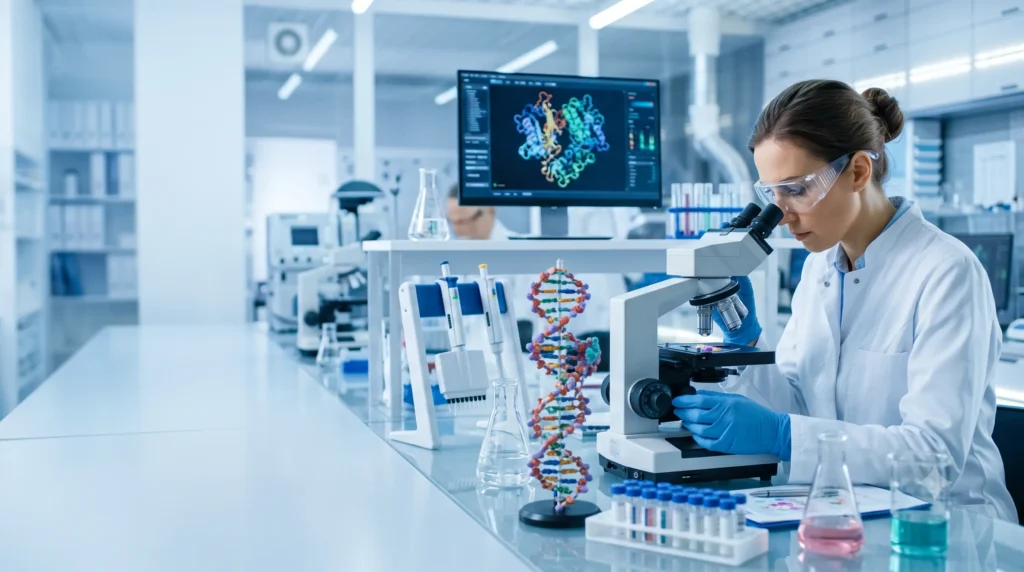
Biotechnology Scientific Research is one of the fastest-growing areas of modern science, combining biology, technology, engineering, and data science to develop new approaches for studying biological systems. Biotechnology Research supports scientific investigation across molecular biology, genetics, biochemistry, microbiology, agriculture, environmental science, industrial research, and many other scientific disciplines.
Modern Biotechnology Applications combine biological organisms, cells, molecules, and biological processes with advanced laboratory technologies to support scientific investigation and innovation.
From DNA sequencing and molecular biology to laboratory automation and advanced analytical equipment, biotechnology has transformed modern Laboratory Research. Researchers can now investigate biological systems with greater precision, process large datasets, and develop increasingly sophisticated research methodologies.
In this guide, we explore what biotechnology is, how Biotechnology Scientific Research has evolved, major biotechnology applications, commonly used laboratory technologies, and the future of biotechnology research.
What Is Biotechnology?
Biotechnology is the application of biological systems, living organisms, cells, or biological molecules to develop technologies, improve processes, and support Scientific Research.
Modern biotechnology is a multidisciplinary field that combines:
- Biology
- Chemistry
- Genetics
- Microbiology
- Biochemistry
- Molecular biology
- Engineering
- Computer science
- Bioinformatics
- Data science
According to the National Library of Medicine, molecular biology examines the structure and function of molecules and macromolecular systems involved in biological processes, including DNA replication, gene expression, protein synthesis, genomics, and proteomics. NCBI
This multidisciplinary approach allows Biotechnology Research teams to investigate complex biological questions using different scientific methods and technologies.
A Brief History of Biotechnology
Although modern biotechnology is associated with advanced laboratories and molecular technologies, biotechnology has much older origins.
Ancient Biotechnology
Early civilizations used biological processes for practical purposes, including:
- Bread making
- Cheese production
- Fermentation
- Brewing
- Food preservation
These early applications demonstrated that biological organisms and processes could be used to produce useful materials even before the underlying science was understood.
Modern Biotechnology
Scientific discoveries during the twentieth century dramatically expanded Biotechnology Research.
Important developments included:
- Discovery of DNA structure
- Recombinant DNA technology
- Polymerase Chain Reaction (PCR)
- Automated DNA sequencing
- Protein engineering
- Genetic analysis
- Synthetic biology
These developments created new opportunities for Biotechnology Scientific Research and transformed modern laboratory science.
Major Areas of Biotechnology
Biotechnology includes numerous specialized branches. Each area uses biological systems and laboratory technologies to address different scientific questions.
Medical Biotechnology Research
Medical biotechnology involves research into biological systems, cells, proteins, genetic information, and other biological materials.
Research areas can include:
- Molecular biology research
- Protein analysis
- Cell biology
- Immunology
- Diagnostic research
- Biomolecular analysis
- Laboratory testing
These Biotechnology Applications help researchers investigate biological processes and develop new laboratory methods.
Agricultural Biotechnology
Agricultural biotechnology applies biological science and technology to plant and agricultural research.
Common research areas include:
- Plant genetics
- Crop improvement research
- Disease resistance research
- Soil microbiology
- Plant molecular biology
- Sustainable agriculture research
Agricultural Biotechnology Research allows scientists to investigate plant biology, genetic characteristics, and biological processes associated with agricultural systems.
Industrial Biotechnology
Industrial biotechnology uses biological processes and organisms in manufacturing and industrial research.
Applications can include:
- Enzyme research
- Bio-based manufacturing
- Industrial fermentation
- Sustainable materials research
- Bioprocess optimization
- Microbial research
Industrial Biotechnology Applications combine biology with engineering and laboratory technology to investigate efficient and potentially more sustainable production methods.
Environmental Biotechnology
Environmental biotechnology applies biological science to environmental research.
Research areas can include:
- Water treatment research
- Waste management research
- Environmental monitoring
- Bioremediation research
- Microbial ecology
- Renewable resource research
These applications demonstrate how Biotechnology Scientific Research extends beyond traditional laboratory biology into environmental and ecological research.
Biotechnology in Scientific Research
Modern Biotechnology Scientific Research plays an important role in laboratories across many scientific disciplines.
Researchers use biotechnology technologies to:
- Analyze biological molecules
- Study protein interactions
- Investigate cellular processes
- Examine genetic information
- Develop laboratory models
- Improve analytical methods
- Analyze biological datasets
- Support scientific innovation
The integration of biotechnology with advanced laboratory technology allows scientists to investigate biological systems with increasing precision.
For researchers interested in laboratory research materials, Lab Rat Peptides provides a dedicated collection of Research Peptides, including peptide research materials and other laboratory research compounds. Lab Rat Peptides
Molecular Biology and Biotechnology Research
Molecular biology is a fundamental component of modern Biotechnology Research.
Researchers study molecules and molecular systems involved in biological processes, including:
- DNA
- RNA
- Proteins
- Enzymes
- Genes
- Cellular signaling
- Gene expression
The National Library of Medicine describes molecular biology as the study of molecular structures and systems associated with biological processes, including inheritance and protein synthesis. NCBI
This makes molecular biology an important foundation for Biotechnology Scientific Research.
Laboratory Technologies Used in Biotechnology
Modern biotechnology laboratories use a wide range of advanced laboratory technologies to support Scientific Research.
Common technologies include:
- High-Performance Liquid Chromatography (HPLC)
- Mass Spectrometry (MS)
- Polymerase Chain Reaction (PCR)
- DNA sequencing
- Flow cytometry
- Fluorescence microscopy
- Cell culture equipment
- Laboratory automation systems
- Laboratory information management systems
These technologies support different types of Laboratory Research, from molecular analysis to biological characterization.
DNA Sequencing in Biotechnology
DNA sequencing is one of the most important technologies in modern Biotechnology Research.
DNA sequencing determines the order of nucleotide bases within a DNA molecule. The National Human Genome Research Institute explains that sequencing provides information about the genetic sequence contained within DNA. Genome.gov
Researchers use sequencing technologies for areas such as:
- Genomic research
- Molecular biology
- Genetic analysis
- Comparative biology
- Biotechnology research
- Bioinformatics
The continued development of sequencing technology has significantly expanded the capabilities of Biotechnology Scientific Research.
HPLC and Analytical Biotechnology Research
High-Performance Liquid Chromatography, commonly known as HPLC, is widely used in analytical Laboratory Research.
HPLC can separate and analyze components within complex mixtures and can be useful for:
- Compound analysis
- Purity assessment
- Sample characterization
- Analytical research
- Quality testing
Analytical technologies such as HPLC can therefore contribute to quality-focused Biotechnology Research and laboratory analysis.
For researchers working with peptide research materials, Lab Rat Peptides provides product information and testing documentation for applicable products. Its catalog describes independent testing using techniques including HPLC and mass spectrometry. Lab Rat Peptides
Mass Spectrometry in Biotechnology
Mass spectrometry is another important analytical technology used in Biotechnology Scientific Research.
Mass spectrometry provides information about molecular mass and composition and can be used in research involving:
- Proteins
- Peptides
- Metabolites
- Biological molecules
- Molecular characterization
The combination of mass spectrometry with other analytical technologies can provide researchers with more detailed information about laboratory samples.
For example, Lab Rat Peptides product pages describe third-party mass spectrometry and HPLC testing for applicable research products. Lab Rat Peptides
The Role of Data and Automation
Modern Biotechnology Research increasingly depends on digital technologies.
Laboratories now use:
- Laboratory Information Management Systems (LIMS)
- Artificial Intelligence (AI)
- Machine learning
- Robotic laboratory automation
- Digital data analysis
- Cloud-based research platforms
- Computational biology
- Bioinformatics
These technologies help laboratories organize large datasets, automate repetitive workflows, improve efficiency, and support reproducible Laboratory Research.
The NCBI provides databases and computational resources supporting molecular biology and bioinformatics research, making it a useful reference for researchers working with biological datasets. NCBI
Artificial Intelligence in Biotechnology Research
Artificial intelligence is becoming increasingly important in modern Biotechnology Research.
Researchers can use AI and machine learning to analyze large scientific datasets, identify patterns, analyze biological images, and support computational modeling.
AI can help researchers:
- Analyze complex biological datasets
- Identify patterns in research data
- Analyze laboratory images
- Optimize laboratory workflows
- Support predictive modeling
- Organize large research datasets
The combination of artificial intelligence and Biotechnology Scientific Research is creating new opportunities for data-driven laboratory investigation.
Biotechnology Applications in Research Materials
Modern Laboratory Research may require different types of biological and biochemical materials depending on the research objective.
Researchers can explore specialized research categories such as:
- Research Peptides — peptide research materials and laboratory compounds. Lab Rat Peptides
- Amino Acids — amino-acid-related research materials. Lab Rat Peptides
- Biochemicals — biochemical research materials.
- Research Compounds — specialized research compounds.
- Single Vitamins — individual vitamin research materials.
- Topical Peptides — topical peptide research materials.
Your current shop structure exposes these categories as distinct research categories, which is useful for creating a clear internal topical structure. Lab Rat Peptides
Quality Assurance in Laboratory Research
Reliable Scientific Research depends on appropriate quality management, documentation, and laboratory procedures.
Laboratories may implement practices including:
- Good Laboratory Practices (GLP)
- Equipment calibration
- Documentation standards
- Batch traceability
- Routine quality testing
- Standard operating procedures
- Data integrity procedures
These practices help laboratories maintain consistency and improve the reproducibility of Laboratory Research.
For research materials, documentation such as Certificates of Analysis can provide additional information about individual batches and analytical testing.
Lab Rat Peptides states that its research products are supported by batch-specific COA documentation where available and that its catalog uses third-party analytical testing. Lab Rat Peptides
You can learn more about the available research products through the Lab Rat Peptides research catalog. Lab Rat Peptides
Emerging Biotechnology Applications
Modern biotechnology continues to evolve rapidly.
Important emerging Biotechnology Applications include:
Synthetic Biology
Synthetic biology combines biological science with engineering principles to investigate and develop biological systems.
Gene Editing Research
Gene-editing technologies provide researchers with tools for investigating genetic systems and biological processes.
Bioinformatics
Bioinformatics combines biology, computer science, and data analysis to investigate large biological datasets.
Advanced Biomaterials Research
Researchers continue to investigate biological and engineered materials for different scientific applications.
Precision Laboratory Automation
Automated laboratory systems can help improve workflow consistency and allow researchers to process larger numbers of samples.
Digital Biotechnology
Artificial intelligence, computational biology, and digital laboratory technologies are creating new approaches to Biotechnology Scientific Research.
Challenges in Biotechnology Research
Despite rapid technological progress, Biotechnology Research continues to face important challenges.
These include:
- Managing large scientific datasets
- Maintaining research data integrity
- Integrating advanced laboratory technology
- Maintaining quality standards
- Training researchers in emerging technologies
- Supporting interdisciplinary collaboration
- Ensuring reproducibility
- Managing complex research workflows
Addressing these challenges will be important for the continued development of Scientific Research.
The Future of Biotechnology Scientific Research
The future of Biotechnology Scientific Research will likely become increasingly connected to artificial intelligence, automation, computational biology, and advanced analytical technologies.
Researchers continue to explore:
- AI-assisted laboratory systems
- Robotic laboratory automation
- Advanced molecular analysis
- Computational biology
- Bioinformatics
- High-throughput research
- Digital laboratory management
- Sustainable biotechnology technologies
As laboratory technology continues to develop, Biotechnology Research will become increasingly data-driven and interconnected.
The combination of biology, engineering, computing, and advanced laboratory technology will continue expanding the possibilities of Scientific Research.
Conclusion
Biotechnology Scientific Research has become an important foundation of modern scientific discovery. By combining biology with technology, researchers can investigate biological systems, develop analytical methods, and improve laboratory processes.
Modern Biotechnology Research supports numerous Biotechnology Applications, including molecular biology, genetics, biochemistry, environmental research, agricultural research, industrial biotechnology, and analytical science.
As artificial intelligence, automation, molecular biology, and computational science continue to develop, Laboratory Research will become increasingly sophisticated and data-driven.
Biotechnology will therefore remain an important part of modern Scientific Research, helping researchers develop new technologies, improve laboratory methods, and expand scientific knowledge.
Frequently Asked Questions
What is biotechnology?
Biotechnology is the application of biological systems, living organisms, cells, or biological processes to develop technologies, improve processes, and support Scientific Research.
Why is biotechnology important?
Biotechnology supports Biotechnology Research, improves laboratory technologies, enables new Biotechnology Applications, and helps researchers investigate biological systems using increasingly advanced methods.
What industries use biotechnology?
Biotechnology is used across Scientific Research, agriculture, environmental science, industrial manufacturing, food science, biotechnology laboratories, academic research, and many other scientific fields.
Is biotechnology only used in healthcare?
No. Biotechnology Applications extend beyond healthcare into agricultural research, environmental research, industrial biotechnology, food science, molecular biology, and Laboratory Research.
What technologies are used in biotechnology research?
Common technologies include HPLC, mass spectrometry, PCR, DNA sequencing, flow cytometry, advanced microscopy, laboratory automation, artificial intelligence, bioinformatics, and laboratory information management systems.
How does biotechnology support laboratory research?
Biotechnology Research provides biological tools, analytical methods, laboratory technologies, and computational approaches that allow researchers to investigate biological systems and improve Laboratory Research.