

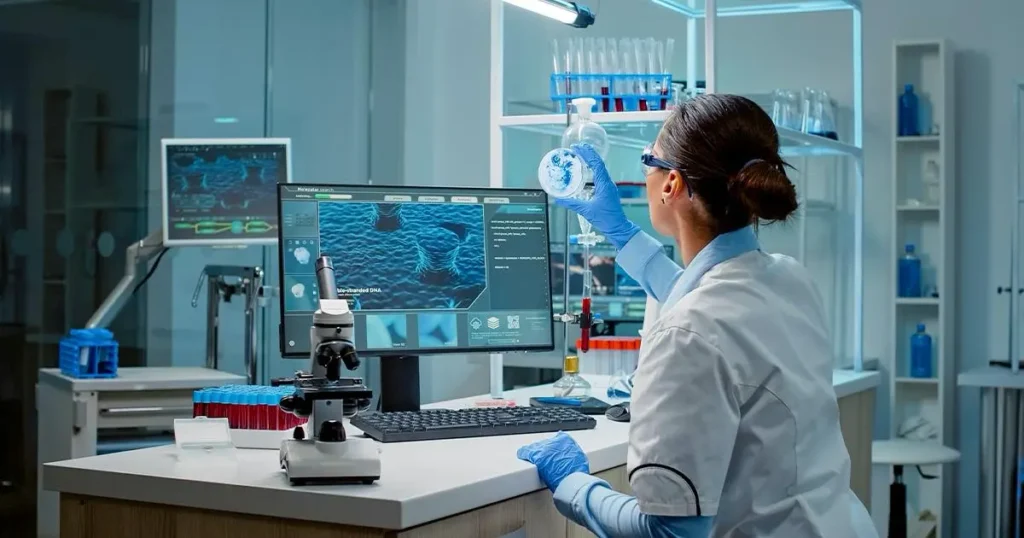
How Biotechnology Research Is Advancing Modern Science
Biotechnology research is transforming how scientists investigate biological systems, analyze complex datasets, and develop advanced laboratory technologies. By combining biology with chemistry, engineering, computing, and analytical science, modern laboratories can investigate increasingly complex scientific questions.
Technologies such as DNA sequencing, mass spectrometry, high-performance liquid chromatography (HPLC), advanced microscopy, automation, and computational analysis have become important components of contemporary laboratory workflows.
Resources from the National Center for Biotechnology Information (NCBI) provide researchers with extensive scientific databases, publications, and computational resources. The National Institutes of Health (NIH) also publishes scientific information supporting molecular biology, genetics, laboratory science, and related fields.
This article examines how biotechnology research has developed, the laboratory technologies supporting scientific investigation, and emerging trends shaping modern biological science.
What Is Biotechnology Research?
Biotechnology research involves the scientific investigation of biological systems, molecules, cells, organisms, and biological processes using laboratory and computational techniques.
The field brings together molecular biology, genetics, biochemistry, microbiology, bioinformatics, analytical chemistry, engineering, data science, and computational biology.
This interdisciplinary structure allows researchers to approach scientific questions from multiple perspectives. A laboratory project may combine molecular analysis with chromatography, mass spectrometry, imaging, sequencing, and computational data processing.
For additional scientific information, researchers can consult the NCBI Bookshelf, which provides access to scientific books, reports, and educational resources covering numerous areas of biological and laboratory science.
The Genomics Research Resources also provides educational and scientific resources related to genomics, sequencing, genetics, and molecular biology.
How Biotechnology Research Has Evolved
Biological science has changed significantly over the past several decades. Earlier laboratory workflows often depended heavily on manual procedures and smaller datasets. Advances in instrumentation and computing have expanded the amount of information researchers can collect, process, and analyze.
Important developments include:
- Polymerase Chain Reaction (PCR)
- DNA sequencing
- Mass spectrometry
- High-throughput screening
- Flow cytometry
- Advanced microscopy
- Laboratory automation
- Bioinformatics
- Computational modeling
- Machine learning
These developments have improved the ability of laboratories to study molecular structures, biological pathways, genetic information, and cellular processes.
Modern analytical systems can process large numbers of samples while producing detailed datasets. Researchers can then use specialized software to organize, compare, and interpret those results.
The combination of laboratory experimentation and computational analysis has become an important feature of contemporary biotechnology research. Researchers can integrate experimental observations with digital datasets to develop a broader understanding of complex biological systems.
Laboratory Technologies Supporting Modern Research
Advanced laboratory technologies provide researchers with tools for examining biological materials and generating analytical information.
Different instruments are designed for different purposes, and many research workflows use several technologies together. Combining analytical methods can provide complementary information and help researchers evaluate experimental samples from multiple perspectives.
HPLC and Analytical Separation
High-performance liquid chromatography, commonly known as HPLC, is an important analytical technique used to separate and evaluate components within complex mixtures.
Researchers can use HPLC to investigate:
- Sample composition
- Purity
- Retention behavior
- Molecular separation
- Analytical consistency
HPLC is widely used across chemistry, biochemistry, molecular science, analytical chemistry, and peptide-related laboratory investigations.
Analytical chromatography can also contribute to quality-control workflows by providing measurable information about the composition and characteristics of a sample.
Mass Spectrometry
Mass spectrometry provides information related to molecular mass and composition and can be applied to peptides, proteins, metabolites, and other molecular materials.
Researchers may combine mass spectrometry with chromatography to obtain more detailed analytical information about complex samples.
This combination can help laboratories investigate molecular characteristics and evaluate components within complex analytical samples.
Mass spectrometry has become an important analytical technology across many areas of biotechnology research, particularly when researchers require detailed molecular information.
DNA Sequencing
DNA sequencing allows researchers to determine the order of nucleotides within DNA molecules.
Sequencing technologies are important tools in genomics, molecular biology, genetics, and related scientific disciplines.
Modern sequencing platforms can generate large datasets that require specialized computational methods for organization and analysis.
Researchers can use sequencing information to investigate genetic variation, molecular relationships, biological pathways, and other scientific questions.
Resources from the National Center for Biotechnology Information provide access to genomic databases and computational resources that support many areas of biological data analysis.
Flow Cytometry
Flow cytometry enables researchers to analyze individual cells and cellular populations.
The technology can provide information about physical and molecular characteristics of cells and is commonly used across cellular biology, microbiology, molecular science, and related laboratory disciplines.
Because large numbers of cells can be evaluated efficiently, flow cytometry can generate substantial datasets for further analysis.
The resulting information can then be integrated with other experimental measurements as part of broader laboratory workflows.
Advanced Microscopy
Modern microscopy provides increasingly detailed views of biological structures.
Depending on the technique, researchers can investigate cellular structures, microorganisms, tissues, molecular interactions, and other biological features.
Advanced imaging systems can also produce large digital datasets that can be analyzed using specialized software and computational methods.
Image-based analysis is therefore becoming an increasingly valuable component of modern biotechnology research, particularly when researchers need to quantify visual characteristics rather than relying only on qualitative observations.
The Role of Laboratory Automation
Automation is becoming increasingly important as laboratory workflows become more complex.
Automated systems can perform repetitive procedures using standardized parameters, reducing the amount of manual work required for certain experimental processes.
Examples include:
- Robotic liquid handling
- Automated sample preparation
- Plate handling
- High-throughput screening
- Automated imaging
- Instrument integration
- Digital laboratory management
Automation can help laboratories process larger numbers of samples while maintaining consistent procedures.
It can also improve workflow efficiency by connecting multiple stages of an experiment. Automated instruments can transfer information between different stages, reducing repetitive data-entry requirements and supporting more standardized laboratory operations.
Researchers can then devote more time to experimental design, data analysis, interpretation, and scientific decision-making.
Artificial Intelligence in Biotechnology Research
Artificial intelligence is creating additional opportunities for biotechnology research and laboratory data analysis.
Modern computational systems can process large datasets, identify patterns, classify images, and support predictive modeling.
Potential applications include:
- Biological image analysis
- Pattern recognition
- Dataset classification
- Predictive modeling
- Experimental workflow optimization
- Automated data processing
AI-based tools can complement laboratory experimentation by helping researchers analyze information generated by instruments, databases, and imaging systems.
For example, image-analysis systems can examine large numbers of laboratory images and identify patterns that may require further scientific investigation.
Machine-learning methods can also assist with the classification and organization of large datasets. However, computational outputs still require appropriate validation, experimental context, and scientific interpretation.
Data Science and Biological Research
Modern laboratories generate substantial amounts of information.
Sequencing systems, analytical instruments, imaging platforms, and automated workflows can each produce datasets requiring specialized analysis.
Data science provides methods for organizing and interpreting this information, including:
- Statistical analysis
- Machine learning
- Data visualization
- Bioinformatics
- Computational modeling
- Database management
- Cloud computing
Researchers can use these methods to identify relationships within large datasets and compare experimental results across different conditions.
The National Center for Biotechnology Information provides databases and computational resources that support biological data analysis and scientific investigation.
The increasing connection between laboratory experimentation and computational science is helping researchers manage larger and more complex datasets.
Bioinformatics is particularly important because modern sequencing and molecular-analysis technologies can produce datasets that would be difficult to evaluate efficiently through manual approaches alone.
Improving Accuracy and Reproducibility
Reproducibility is an important consideration in scientific investigation.
Laboratories can improve consistency by establishing standardized procedures, maintaining detailed records, and applying appropriate quality-control processes.
Important practices include:
- Equipment calibration
- Standard operating procedures
- Sample identification
- Data documentation
- Quality-control testing
- Analytical verification
- Digital record keeping
- Sample traceability
Consistent laboratory procedures make experimental results easier to evaluate and reproduce.
Detailed documentation can also help researchers understand how a result was generated and identify potential sources of variation.
For complex projects involving multiple instruments and analytical techniques, careful documentation becomes particularly important.
Quality systems can help laboratories establish repeatable workflows while maintaining appropriate records of samples, instruments, analytical procedures, and experimental observations.
Research Materials and Analytical Quality
The quality and documentation of research materials can influence laboratory workflows.
Researchers may evaluate materials using analytical techniques such as HPLC, mass spectrometry, chromatography, spectroscopy, and other laboratory methods.
Certificates of analysis and related documentation can provide additional information about applicable research materials and analytical testing.
LabRat Peptides offers specialized laboratory research materials across categories including:
- Research Peptides
- Research Compounds
- Amino Acid Research
- Molecular Research Compounds
- CNS Signaling Research
- Receptor Signaling Research
- Dermal Research
- Biochemical Reference Compounds
Researchers should review available product documentation, analytical information, storage requirements, and laboratory specifications before incorporating a material into an experimental workflow.
Appropriate laboratory procedures and institutional requirements should always be followed when handling research materials.
Analytical documentation can be particularly useful when researchers need to understand the available testing information associated with a research material. Depending on the material and application, researchers may review chromatographic, spectrometric, or other analytical data.
Emerging Areas of Biotechnology Research
The field continues to expand as researchers develop new technologies and analytical approaches.
Synthetic Biology
Synthetic biology combines biological science with engineering principles.
Researchers can use these approaches to investigate biological systems, construct experimental models, and explore new methods for studying biological processes.
The field combines concepts from molecular biology, genetics, engineering, chemistry, and computational science.
Synthetic biology is an important area of biotechnology research because it encourages researchers to examine biological systems using both experimental and engineering-based approaches.
Gene Editing
Gene-editing technologies provide researchers with tools for studying genetic systems.
Scientists can investigate specific genetic changes and examine their effects within controlled experimental environments.
These techniques have expanded the range of methods available for molecular and genetic investigation.
Gene-editing research also relies heavily on sequencing, molecular analysis, computational tools, and appropriate experimental controls.
Bioinformatics
Bioinformatics combines biology, computing, statistics, and data analysis.
Researchers can use computational approaches to:
- Compare biological sequences
- Organize genomic information
- Analyze large datasets
- Identify molecular patterns
- Study biological relationships
- Develop computational models
As biological datasets continue to grow, bioinformatics is becoming increasingly important for modern laboratory science.
Computational analysis allows researchers to process information generated by sequencing platforms and other laboratory technologies while supporting the organization and interpretation of complex datasets.
Biomaterials
Biomaterials research investigates materials that interact with biological systems.
This field combines materials science, chemistry, engineering, molecular biology, and other disciplines.
Researchers investigate material properties, biological interactions, structural characteristics, and potential scientific applications.
The interdisciplinary nature of biomaterials development demonstrates how modern biotechnology research increasingly connects biological science with engineering and materials science.
Biological Imaging
Advanced imaging technologies continue to improve the ability of researchers to investigate biological structures.
Modern systems can generate detailed images and large datasets that can subsequently be evaluated through computational analysis.
Imaging can therefore serve as both an experimental technique and a source of quantitative research data.
Sustainable Biotechnology
Scientists are also exploring biological approaches that may contribute to more efficient industrial, agricultural, environmental, and laboratory processes.
This area includes research involving microorganisms, enzymes, biological materials, and other scientific systems.
Sustainable biotechnology combines biological investigation with efforts to understand resource efficiency, biological production systems, and environmentally focused scientific processes.
Challenges in Modern Biotechnology
Rapid technological development also creates new challenges for laboratories.
Common considerations include:
- Managing large datasets
- Maintaining data integrity
- Ensuring experimental consistency
- Integrating new instruments
- Training laboratory personnel
- Maintaining analytical equipment
- Managing research documentation
- Establishing standardized workflows
Laboratories must also evaluate whether new technologies are appropriate for their specific research requirements.
Introducing advanced equipment without suitable training, documentation, maintenance, and quality-control procedures can create additional complexity.
Data management is another important consideration. As laboratories adopt sequencing, imaging, automation, and computational systems, the amount of information requiring storage, organization, validation, and analysis continues to increase.
Successful laboratory operations therefore require a combination of technology, scientific expertise, careful planning, and standardized procedures.
The Future of Biotechnology Research
Future developments are likely to involve greater integration between laboratory experimentation, automation, artificial intelligence, and computational science.
Important areas of continued development may include:
- AI-assisted laboratory workflows
- Robotic automation
- Advanced molecular analysis
- High-throughput experimentation
- Computational biology
- Genomics
- Bioinformatics
- Digital laboratory platforms
- Advanced analytical instrumentation
As these technologies become more interconnected, researchers may be able to coordinate laboratory instruments, computational systems, and analytical platforms more efficiently.
Greater automation could also reduce repetitive laboratory procedures and allow researchers to focus more heavily on experimental design and interpretation.
The continued development of analytical technologies will provide additional opportunities for studying biological systems at molecular, cellular, and computational levels.
The future of biotechnology research will likely depend not on one individual technology, but on the integration of multiple scientific disciplines. Laboratory instruments, computational platforms, databases, automation systems, and analytical methods can work together to create increasingly connected research environments.
Conclusion
Biotechnology research is an increasingly important part of modern scientific investigation.
Advances in molecular biology, analytical chemistry, sequencing, microscopy, automation, artificial intelligence, and computational science have expanded laboratory capabilities.
Modern scientific workflows increasingly combine multiple technologies rather than relying on a single experimental method. This approach can provide researchers with broader datasets and multiple perspectives on complex biological questions.
As analytical instruments become more sophisticated and computational tools continue to advance, laboratories will have increasingly powerful methods for collecting, processing, and interpreting scientific information.
LabRat Peptides supports laboratory-focused scientific investigation with a range of specialized research materials and analytical documentation for applicable products.
Frequently Asked Questions
What is biotechnology research?
Biotechnology research involves the investigation of biological systems, molecules, cells, and biological processes using laboratory, analytical, and computational methods.
How is biotechnology research used in scientific investigation?
It provides researchers with tools and techniques for studying biological systems, analyzing molecular materials, investigating genetic information, and developing laboratory technologies.
What technologies are commonly used in biotechnology?
Common technologies include HPLC, mass spectrometry, DNA sequencing, flow cytometry, advanced microscopy, laboratory automation, and computational data analysis.
How is artificial intelligence used in biotechnology research?
Artificial intelligence can assist with image analysis, pattern recognition, dataset classification, predictive modeling, and laboratory workflow optimization.
Why is laboratory automation important?
Laboratory automation can reduce repetitive manual procedures, improve workflow consistency, process larger sample volumes, and integrate different stages of laboratory operations.
Why is data analysis important in biotechnology?
Modern laboratory instruments can generate large datasets. Statistical analysis, bioinformatics, machine learning, and computational modeling can help researchers organize and interpret this information.
What role does HPLC play in biotechnology research?
HPLC is an analytical separation technique that can help researchers examine sample composition, separation behavior, purity-related measurements, and analytical consistency.
How do researchers improve laboratory reproducibility?
Researchers can support reproducibility through standardized procedures, equipment calibration, sample traceability, detailed documentation, quality-control testing, and appropriate analytical verification.