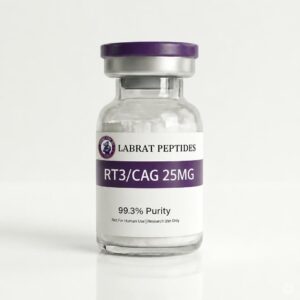
Every batch of Labrat Peptides undergoes third-party Mass Spectrometry and HPLC analysis. We believe in absolute transparency - since in third-party marketing we need complete confidence.
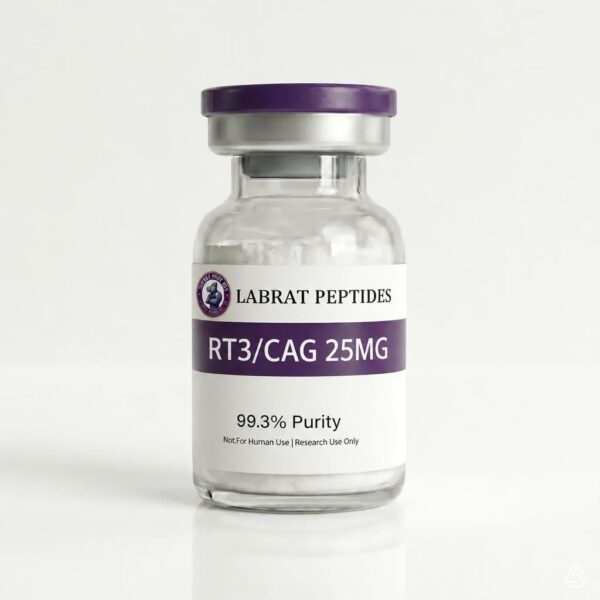
RT3 / CAG 25MG Blend is a laboratory research material supplied as a defined peptide blend for controlled scientific investigation, analytical characterization, biochemical research, molecular studies, and related laboratory workflows.
The 25MG presentation provides a defined quantity of research material for laboratories conducting controlled experimental work involving peptide characterization, sample preparation, analytical testing, molecular interactions, and other research applications where a documented peptide blend is appropriate.
A peptide blend can provide researchers with a defined research material for investigating the characteristics and behavior of multiple molecular components within a controlled experimental environment. Depending on the research protocol, investigations may involve analytical characterization, chromatographic analysis, molecular-mass evaluation, stability research, biochemical assays, or other validated laboratory methods.
Researchers should review the applicable product documentation, batch information, Certificate of Analysis (COA), Safety Data Sheet (SDS), and laboratory procedures before working with the material.
FOR RESEARCH USE ONLY.
RT3 / CAG 25MG Blend is presented as a research-oriented peptide blend intended for controlled laboratory investigation.
The term blend indicates that the research material contains multiple defined components within a single product presentation. The exact composition, ratio, concentration, and analytical characteristics should be determined from the applicable product documentation and batch-specific information.
Research involving peptide blends can involve several areas of laboratory science, including:
The specific research application depends on the experimental design and the characteristics of the material being investigated.
Research involving peptide blends can provide opportunities to investigate the characteristics of multiple molecular components under controlled laboratory conditions.
A laboratory may evaluate a research blend using analytical techniques designed to identify, separate, characterize, or compare individual components.
Potential research objectives can include:
Researchers should establish appropriate experimental procedures according to the characteristics of the material and the objective of the research.
Peptide blends can be investigated using analytical and biochemical approaches designed to understand the properties of their individual components and the combined research material.
A controlled peptide research workflow may involve:
The use of a defined research material can help laboratories maintain consistent sample identification throughout an experimental workflow.
Batch information should be retained alongside analytical records to support traceability.
Molecular characterization is an important component of peptide research.
Researchers may investigate characteristics such as:
Different analytical methods can provide complementary information about a research material.
For a peptide blend, chromatographic separation can be particularly useful because multiple molecular components may produce different analytical signals.
High-performance liquid chromatography, commonly referred to as HPLC, is widely used for analytical characterization.
HPLC can help researchers evaluate the chromatographic profile of a research material under defined analytical conditions.
Potential research observations can include:
For a peptide blend, chromatography may also help researchers examine differences between individual components.
The analytical method should be selected according to the characteristics of the research material and the laboratory's validated procedures.
Reverse-phase HPLC is commonly used in peptide analytical research.
This approach can separate molecular components according to their interaction with the chromatographic system.
Researchers may evaluate:
For a blend containing multiple peptide components, a suitable chromatographic method can provide useful information regarding the analytical profile of the research material.
Researchers should use appropriate standards, controls, and validated analytical procedures when conducting chromatographic investigations.
Liquid chromatography-mass spectrometry, or LC-MS, combines chromatographic separation with mass-based detection.
This approach can provide valuable information for molecular characterization of research materials.
Depending on the analytical method, LC-MS research may help investigate:
For research blends, LC-MS can be particularly useful when researchers need to examine individual molecular components within a combined material.
Mass spectrometry can provide molecular-mass information useful for research material characterization.
Researchers may use mass spectrometry to investigate:
When combined with chromatographic separation, mass spectrometry can provide additional information about individual components within a research blend.
The interpretation of analytical results should be performed using appropriate reference information, validated methods, and suitable laboratory controls.
Analytical characterization can help laboratories establish a clearer understanding of research material properties.
Depending on the applicable analytical program, characterization may include:
No single analytical technique necessarily provides every type of information required for a research material.
Researchers may therefore use complementary methods depending on the objective of the investigation.
Purity assessment is an important component of analytical peptide research.
Researchers may use chromatographic and mass-based techniques to evaluate the analytical profile of a research material.
For a blend, the concept of purity can require careful interpretation because the product is intentionally presented as a combination of defined molecular components.
Batch-specific analytical documentation should therefore be reviewed when evaluating the characteristics of the product.
Laboratories should use appropriate analytical methods and reference standards when making comparisons.
Stability research examines how the characteristics of a research material may change under defined environmental conditions.
Factors that can influence peptide stability can include:
Researchers can design controlled stability studies to compare analytical characteristics over defined periods.
Analytical techniques such as HPLC and LC-MS can potentially be used to monitor changes in the research material.
Appropriate sample preparation is an important part of analytical research.
Before analysis, researchers may need to prepare a sample according to the requirements of the selected analytical method.
Sample preparation can involve:
The specific preparation procedure should be established by appropriately trained laboratory personnel according to the research protocol and applicable product documentation.
Peptide research materials can be incorporated into controlled biochemical investigations where appropriate.
Biochemical research may examine:
The exact application depends on the research objective and experimental design.
Researchers should evaluate compatibility between the material and the selected experimental system before beginning laboratory work.
Molecular interaction studies investigate how molecules interact under controlled experimental conditions.
For peptide research, researchers may investigate interactions involving:
Research methods may include biochemical assays, binding experiments, molecular modeling, analytical techniques, or other validated laboratory approaches.
Results should be interpreted within the specific conditions and limitations of the experimental system.
Structural research can provide information about molecular characteristics and interactions.
Researchers may investigate:
Computational modeling, spectroscopy, chromatography, mass spectrometry, and other analytical techniques may be used depending on the research objective.
The combination of multiple analytical approaches can provide a broader understanding of a research material.
Because RT3 / CAG 25MG Blend is presented as a blend, researchers may be interested in characterizing the material as a combined research sample.
Blend characterization can involve:
Researchers should refer to the applicable product documentation for composition-related information rather than relying on generalized descriptions.
The specific analytical profile may depend on the batch and the analytical methodology used.
Batch documentation is an important part of laboratory research.
Researchers may maintain records containing:
Maintaining batch records can help laboratories track materials throughout an experimental workflow.
It can also support comparison between different research batches when appropriate analytical information is available.
A Certificate of Analysis (COA) provides batch-specific analytical information associated with a research product.
Depending on the applicable testing program, a COA may include:
Researchers should review the COA associated with their specific batch.
Batch documentation should be retained as part of appropriate laboratory records.
RT3 / CAG 25MG Blend may be relevant to several areas of controlled research.
Investigation of molecular and analytical characteristics of peptide research materials.
Evaluation of research material using HPLC and related chromatographic methods.
Investigation of molecular-mass characteristics and analytical profiles.
Combined chromatographic and mass-based characterization of research materials.
Investigation of molecular interactions and biochemical systems.
Evaluation of changes in analytical characteristics under defined experimental conditions.
Preparation of research materials for analytical and experimental workflows.
Investigation of molecular characteristics and interactions using controlled laboratory methods.
When evaluating a peptide research material, laboratories may consider several documentation and quality factors.
These can include:
Clear documentation can help researchers maintain organized laboratory records and improve traceability throughout the experimental process.
Researchers should evaluate product-specific information rather than relying on generalized specifications.
Storage conditions can influence the stability and integrity of research materials.
Researchers should follow the current product-specific storage instructions supplied by the manufacturer.
Relevant storage considerations can include:
Containers should remain clearly labeled and appropriately secured within the laboratory environment.
If product-specific storage information is provided, that information should take priority over generalized storage recommendations.
RT3 / CAG 25MG Blend should be handled by appropriately trained laboratory personnel within a suitable research environment.
Standard laboratory procedures may include:
Researchers should review the applicable product documentation and SDS before laboratory work.
Laboratory personnel should also follow institutional safety procedures and applicable requirements for research material handling.
A controlled workflow can help researchers maintain consistency throughout an investigation.
A laboratory workflow may include:
Confirm the product identity, batch information, and available documentation.
Review the COA, SDS, storage information, and relevant product documentation.
Establish the analytical or research objective before beginning sample preparation.
Prepare the research material according to the laboratory's established procedure.
Use an appropriate validated analytical method for the research objective.
Record analytical observations and experimental results.
Evaluate the collected data using appropriate analytical methods and controls.
Maintain records of the material, experimental conditions, analytical method, and results.
This type of structured workflow can support laboratory traceability and research reproducibility.
Reproducibility is an important consideration in scientific research.
Researchers can improve experimental traceability by documenting:
When these records are maintained consistently, laboratories can more easily compare results between experiments.
Batch-specific documentation can also help researchers distinguish differences associated with materials, experimental conditions, or analytical procedures.
A clearly identified research material can support organized laboratory workflows.
Relevant considerations include:
Researchers should review the documentation associated with the specific product and batch before beginning experimental work.
RT3 / CAG 25MG Blend is a defined peptide research material supplied for controlled laboratory investigation, analytical characterization, biochemical research, molecular studies, and related research workflows.
The 25MG presentation identifies the quantity of research material supplied in the product. Researchers should review the product documentation for additional batch-specific information.
Yes. The product is presented as a laboratory research material for controlled scientific investigation.
Potential research areas include peptide characterization, analytical chemistry, HPLC research, LC-MS analysis, mass spectrometry, molecular research, biochemical investigation, and stability studies.
HPLC may be used as an analytical technique for appropriate peptide research materials. The specific method should be selected according to the laboratory's validated analytical procedure.
LC-MS can provide chromatographic and molecular-mass information and may be appropriate for characterization of suitable peptide research materials.
Batch information supports traceability and allows researchers to associate analytical observations with a specific research material batch.
A COA can provide batch-specific analytical information such as product identification, testing information, analytical results, and applicable specifications.
Researchers should follow the current product-specific storage instructions supplied with the product.
The material should be handled by appropriately trained laboratory personnel using suitable laboratory procedures.
Yes. Researchers should evaluate material compatibility with the selected experimental system and analytical method before beginning research.
Researchers can consult established scientific databases and educational resources when reviewing peptide chemistry, analytical methods, molecular research, and laboratory science.
PubMed provides access to scientific publications covering a wide range of research areas.
NCBI Bookshelf provides educational reference material covering molecular biology, biochemistry, laboratory methods, and related scientific subjects.
National Institute of Standards and Technology provides scientific and measurement resources relevant to analytical research and laboratory practices.
These resources can complement product-specific documentation, COA information, SDS documentation, and laboratory protocols.
Researchers can explore additional research materials available through LabRat Peptides.
For educational information covering peptide science, analytical testing, laboratory procedures, material handling, and research topics, visit the LabRat Peptides Research Hub.
Internal links to relevant research categories and related materials can also help create a stronger research-focused information structure across the website.
FOR RESEARCH USE ONLY.
RT3 / CAG 25MG Blend is supplied as research material for controlled scientific investigation, analytical characterization, biochemical research, molecular studies, and related laboratory applications.
The information provided on this page is intended for scientific and educational purposes. Researchers are responsible for reviewing applicable product documentation, COA information, SDS documentation, laboratory procedures, institutional requirements, and relevant regulations before conducting research.
Researchers should evaluate material compatibility, maintain appropriate laboratory records, and use validated procedures suitable for their specific experimental objectives.
This product page does not provide instructions for personal application, dosage, or administration.
| Sequence | Available on COA |
| Appearance | White Lyophilized Powder |
| Mol. Weight | 1419.6 g/mol |
| Purity | 99.2% |
| Storage | -20°C or below |