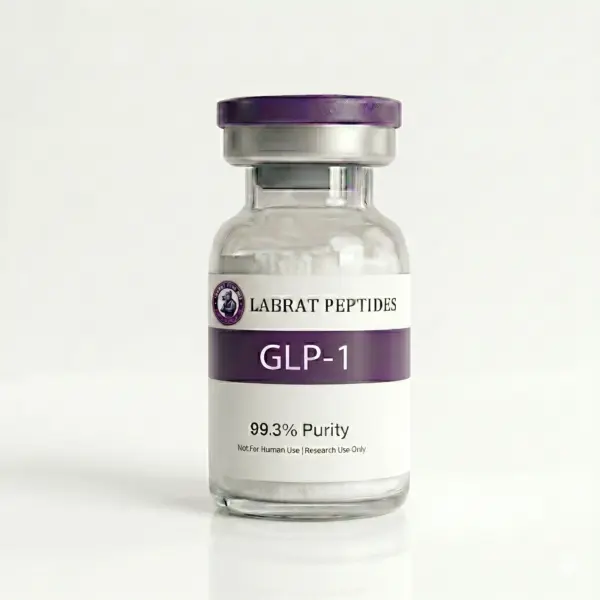
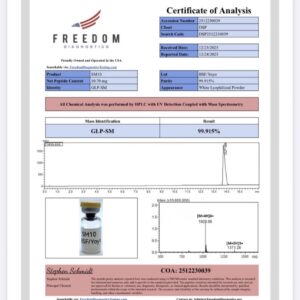
Every batch of Labrat Peptides undergoes third-party Mass Spectrometry and HPLC analysis. We believe in absolute transparency - since in third-party marketing we need complete confidence.
GLP-1 Sema is a semaglutide-based research peptide supplied for controlled laboratory investigation, analytical testing, biochemical research, peptide characterization, and scientific study.
Semaglutide is a long-acting glucagon-like peptide-1 receptor (GLP-1R) agonist. The compound is a modified peptide containing 31 amino acids and is structurally related to human GLP-1. PubChem
Research involving semaglutide has contributed to the study of GLP-1 receptor signaling, peptide pharmacology, metabolic biology, receptor-ligand interactions, and related biochemical pathways.
GLP-1 Sema from LabRat Peptides is intended strictly for Research Use Only (RUO) applications.
It is not intended for human consumption, self-administration, therapeutic use, clinical treatment, diagnosis, disease prevention, veterinary use, or food applications.
Researchers can explore additional GLP Research Peptides and access scientific information through the LabRat Peptides Research Hub.
GLP-1 Sema is a research designation referring to semaglutide, a synthetic GLP-1 receptor agonist.
Semaglutide is a modified peptide designed to have a longer biological duration than native GLP-1. PubChem identifies semaglutide as a 31-amino-acid polypeptide and GLP-1 receptor agonist. PubChem
The compound has been extensively investigated in the scientific literature, making semaglutide an important research molecule for studying:
Researchers should distinguish between the research compound and approved pharmaceutical products containing semaglutide.
The parent semaglutide compound is listed by PubChem with the following characteristics:
| Specification | Semaglutide |
|---|---|
| Compound Name | Semaglutide |
| Common Research Name | GLP-1 Sema |
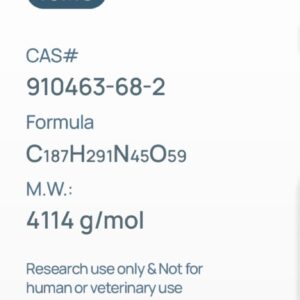
| CAS Number | 910463-68-2 |
| Molecular Formula | C187H291N45O59 |
| Molecular Weight | Approximately 4114 g/mol |
| Peptide Length | 31 amino acids |
| Compound Type | Polypeptide / lipopeptide |
| Receptor Target | GLP-1 receptor |
| Research Classification | Research Use Only |
These values refer to the parent semaglutide compound. If your specific product is semaglutide acetate or semaglutide sodium, the molecular formula and molecular weight are different. PubChem
For that reason, your batch-specific COA should be the final authority for the exact chemical form supplied.
Semaglutide research can be relevant to a variety of laboratory and scientific applications.
Semaglutide is a GLP-1 receptor agonist, making it relevant to controlled investigations into GLP-1 receptor activity and signaling. PubChem
Researchers can use semaglutide as a model compound when studying peptide-receptor interactions and peptide pharmacology.
Semaglutide research can contribute to investigations of receptor-mediated cellular signaling and downstream molecular pathways.
GLP-1 signaling is an important area of metabolic biology research. Semaglutide provides a well-characterized research compound for studying GLP-1-related mechanisms.
Semaglutide can also be studied using analytical techniques designed to characterize peptide identity, purity, molecular weight, and structural properties.
GLP-1 is an endogenous peptide hormone involved in multiple physiological signaling pathways.
Semaglutide was developed as a long-acting GLP-1 analog and has been extensively studied for its interaction with the GLP-1 receptor. PubChem classifies semaglutide as a GLP-1 receptor agonist. PubChem
Research involving GLP-1 receptor agonists can examine:
Researchers should interpret laboratory findings within the context of the specific experimental model and methodology used.
Semaglutide is a relatively large peptide molecule containing 31 amino acids. PubChem reports a molecular formula of C187H291N45O59 for the parent compound. PubChem
The molecular characteristics of a research sample can be evaluated using suitable analytical methods.
Common peptide characterization techniques include:
For research-quality control, analytical results should be evaluated against the specific batch documentation.
Quality verification is an important part of laboratory peptide research.
Researchers purchasing GLP-1 Sema should review the relevant Certificate of Analysis for the exact batch.
Depending on the testing program, analytical documentation may include:
Do not rely on a generic purity value when the actual batch COA is available.
For additional Research Peptides, visit the LabRat Peptides collection.
A Certificate of Analysis (COA) provides batch-specific information about the identity and quality characteristics of a research material.
The COA for GLP-1 Sema may provide information regarding:
Researchers should make sure that the COA corresponds to the exact product batch being used in their laboratory.
Maintaining the COA with the product documentation can help support research-material traceability.
GLP-1 Sema should be stored according to the specific product documentation and batch COA.
For lyophilized peptide research materials, researchers should pay attention to:
Keep the material appropriately sealed and follow the storage requirements supplied with the specific batch.
For more information, visit the LabRat Peptides Research Hub.
You can also read Understanding Lyophilized Research Materials for general educational information.
GLP-1 Sema should be handled by qualified personnel using appropriate laboratory procedures.
Researchers should follow:
Maintain clear product identification and retain batch documentation throughout the research process.
Semaglutide is extensively represented in biomedical research literature.
Researchers can use authoritative scientific databases to investigate semaglutide and GLP-1 receptor research.
These external resources provide researchers with access to scientific literature and molecular information.
FOR RESEARCH USE ONLY. NOT FOR HUMAN OR VETERINARY USE.
GLP-1 Sema is supplied as research material for laboratory investigation, analytical testing, biochemical research, and scientific study.
It is not intended for:
Researchers are responsible for ensuring that research materials are used in accordance with applicable regulations, institutional requirements, laboratory procedures, and approved research protocols.
GLP-1 Sema is a research designation commonly used for semaglutide, a synthetic GLP-1 receptor agonist. Semaglutide is a 31-amino-acid polypeptide. PubChem
Semaglutide is a modified GLP-1 analog that acts on the GLP-1 receptor. PubChem classifies it as a GLP-1 receptor agonist and lists its parent molecular weight at approximately 4114 g/mol. PubChem
Semaglutide contains 31 amino acids. PubChem
The parent semaglutide compound has a molecular weight of approximately 4114 g/mol according to PubChem. PubChem
The molecular formula for parent semaglutide is C187H291N45O59. PubChem
Yes. Semaglutide is classified as a GLP-1 receptor agonist and is extensively studied in GLP-1 receptor and peptide research. PubChem
No. The LabRat Peptides research product is supplied strictly for Research Use Only and is not intended for human or veterinary use.
No. The parent compound and salt/associated forms can have different molecular compositions and molecular weights. PubChem lists semaglutide acetate separately from parent semaglutide. PubChem
Researchers can search PubMed for Semaglutide and review molecular information through PubChem.
Explore the LabRat Peptides Research Peptides Collection for additional laboratory research materials.
Researchers interested in GLP-1 research, semaglutide research, GLP-1 receptor research, peptide pharmacology, peptide characterization, and metabolic research can explore the LabRat Peptides Research Peptide Collection.
For additional scientific and laboratory information, visit the Research Hub.
For educational information about lyophilized materials, see Understanding Lyophilized Research Materials.
FOR RESEARCH USE ONLY. NOT FOR HUMAN OR VETERINARY USE.
GLP-1 Sema is supplied as a laboratory research material for scientific investigation, analytical testing, and biochemical research. It is not intended for human consumption, self-administration, therapeutic use, clinical treatment, diagnosis, prevention of disease, veterinary use, cosmetic use, or food applications.
The information provided on this page is for scientific and educational purposes and should not be interpreted as a recommendation for human use or as a therapeutic claim.
| Sequence | Available on COA |
| Appearance | White Lyophilized Powder |
| Mol. Weight | 1419.6 g/mol |
| Purity | 99.2% |
| Storage | -20°C or below |

All peptides and research chemicals sold on this site are intended exclusively for in-vitro laboratory research. They are not approved for human consumption, medical treatment, veterinary use, or any in-vivo application.