

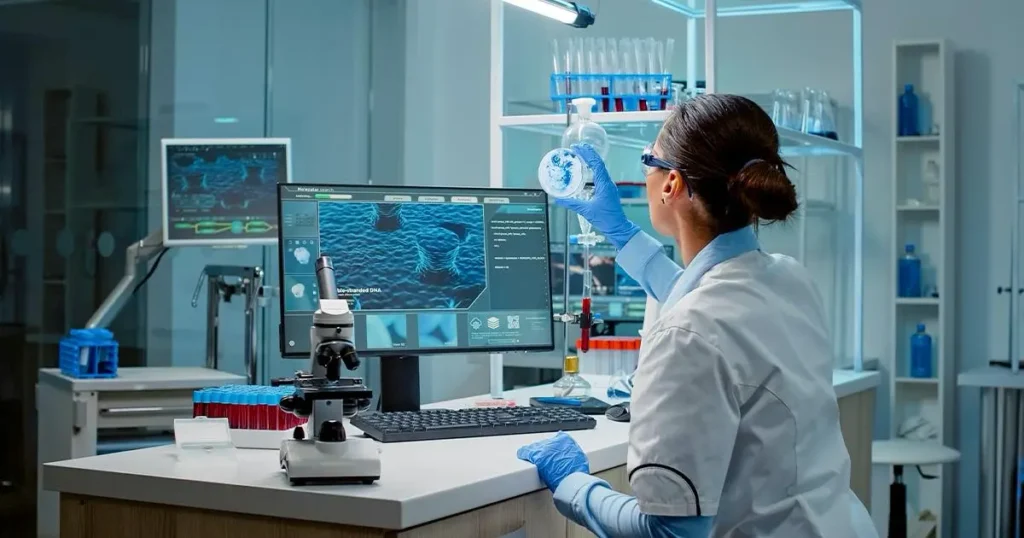
How Biotechnology Research Is Advancing Modern Science
Biotechnology research is changing how scientists study biological systems, analyze complex data, and develop new laboratory technologies. By combining biology with chemistry, engineering, computer science, and advanced analytical tools, researchers can investigate biological processes with greater accuracy and efficiency.
Modern laboratories increasingly rely on technologies such as DNA sequencing, mass spectrometry, high-performance liquid chromatography (HPLC), advanced microscopy, automation, and artificial intelligence. These tools are helping researchers generate, analyze, and interpret increasingly complex scientific data.
Organizations such as the National Center for Biotechnology Information (NCBI) provide researchers with extensive biological and genomic databases that support modern scientific investigation.
This article explores how biotechnology is evolving, the technologies supporting laboratory research, and the innovations shaping the future of scientific discovery.
What Is Biotechnology Research?
Biotechnology research involves the study and application of biological systems, organisms, cells, molecules, and biological processes to investigate scientific questions and develop new technologies.
The field combines several disciplines, including:
- Molecular biology
- Genetics
- Biochemistry
- Microbiology
- Bioinformatics
- Chemistry
- Engineering
- Data science
This interdisciplinary approach allows researchers to investigate biological systems from both experimental and computational perspectives.
Modern laboratories can use biological samples, analytical instruments, computational tools, and automated systems together to obtain more detailed information from experiments.
Resources from the National Human Genome Research Institute provide additional information about genetics, genomics, and DNA-related research.
How Biotechnology Research Has Evolved
Biological research has changed considerably over the past several decades. Earlier laboratory experiments often depended on manual procedures and relatively limited analytical capabilities.
Today, researchers have access to sophisticated instruments capable of analyzing biological materials at molecular and cellular levels.
Some important developments include:
- Polymerase Chain Reaction (PCR)
- DNA sequencing
- Mass spectrometry
- High-throughput screening
- Advanced microscopy
- Flow cytometry
- Laboratory automation
- Bioinformatics
- Machine learning
These technologies allow laboratories to process larger datasets, investigate biological systems in greater detail, and improve experimental consistency.
The National Human Genome Research Institute's DNA sequencing resources provide useful background on one of the technologies that has transformed modern biological investigation.
Laboratory Technologies Supporting Modern Research
Advanced laboratory equipment plays an important role in today's scientific environment. Analytical instruments can help researchers characterize samples, evaluate molecular properties, and generate reproducible experimental data.
HPLC and Analytical Separation
High-performance liquid chromatography (HPLC) is widely used for analytical testing and separation.
Researchers can use HPLC to separate components within complex mixtures and evaluate characteristics such as purity and composition.
HPLC is particularly useful in chemistry, biochemistry, pharmaceutical research, and peptide-related laboratory studies.
For researchers working with specialized laboratory materials, LabRat Peptides provides a Research Peptides collection for research applications.
Mass Spectrometry
Mass spectrometry provides information about molecular mass and composition.
It can be applied to the study of proteins, peptides, metabolites, and other biological molecules. When combined with other analytical methods, mass spectrometry can provide researchers with valuable information about laboratory samples.
DNA Sequencing
DNA sequencing allows scientists to determine the order of nucleotides within DNA molecules.
The technology has become an important part of genomics and molecular biology, supporting research into genetic variation, biological systems, and genomic relationships.
Improvements in sequencing technology have made it possible to analyze increasingly large quantities of genetic information.
Flow Cytometry
Flow cytometry allows researchers to analyze individual cells and cellular populations.
It is commonly used in cellular biology, immunology, molecular biology, and other laboratory disciplines where researchers need to examine characteristics of cells.
Advanced Microscopy
Modern microscopy provides researchers with increasingly detailed views of cells, tissues, microorganisms, and other biological structures.
Advanced imaging methods are particularly valuable in cellular biology, neuroscience, microbiology, and molecular research.
The National Institutes of Health provides extensive resources related to biomedical and biological research.
The Role of Automation in Laboratory Research
Laboratory automation is becoming increasingly important as experiments generate larger numbers of samples and more complex datasets.
Automated systems can perform repetitive procedures with consistent timing and standardized parameters.
Examples include:
- Robotic liquid handling
- Automated sample preparation
- High-throughput screening
- Robotic plate handling
- Automated imaging
- Digital laboratory workflows
Automation can reduce repetitive manual work while helping laboratories improve consistency and efficiency.
It also allows researchers to spend more time on experimental design, data interpretation, and scientific analysis.
Artificial Intelligence and Biotechnology
Artificial intelligence is creating new opportunities across biological and laboratory research.
Modern AI systems can process large datasets, identify patterns, classify images, and assist with predictive modeling.
Potential applications include:
- Biological image analysis
- Data classification
- Pattern recognition
- Predictive modeling
- Research workflow optimization
- Large-scale dataset analysis
AI does not replace laboratory experimentation. Instead, it can complement experimental work by helping researchers interpret information generated by laboratory instruments and databases.
The combination of biological experimentation and computational analysis is becoming increasingly important as datasets continue to grow.
Biotechnology and Data Science
Modern research produces enormous amounts of information.
Genomic sequencing, analytical instruments, imaging systems, and laboratory automation can all generate datasets that require computational analysis.
Data science helps researchers organize and interpret this information through techniques such as:
- Statistical analysis
- Machine learning
- Bioinformatics
- Data visualization
- Computational modeling
- Cloud computing
The NCBI provides databases and computational resources that support biological and genomic research.
As research datasets become larger and more complex, the relationship between laboratory experimentation and computational analysis will continue to grow.
Improving Accuracy and Reproducibility
Reproducibility is an important part of reliable scientific investigation.
Modern laboratory technologies can help researchers standardize experimental procedures and improve documentation.
Important practices include:
- Equipment calibration
- Standard operating procedures
- Digital record keeping
- Quality control
- Sample traceability
- Analytical testing
- Data management
Consistent procedures can make experimental results easier to evaluate and reproduce.
Quality systems are particularly important when research involves complex analytical instruments or large numbers of samples.
Research Materials and Analytical Quality
Reliable research depends not only on sophisticated instruments but also on appropriate laboratory materials and documentation.
Researchers may evaluate materials using analytical techniques such as HPLC and mass spectrometry. Documentation such as certificates of analysis can also provide useful information about individual research batches.
LabRat Peptides provides research materials along with analytical documentation for applicable products. Researchers can explore the Research Compounds category and Amino Acids collection for additional laboratory research materials.
All research materials should be handled according to appropriate laboratory procedures and applicable institutional requirements.
Emerging Areas of Biotechnology
The field continues to expand into new areas of scientific investigation.
Synthetic Biology
Synthetic biology combines biological science with engineering principles to study and design biological systems.
Gene Editing
Gene-editing technologies allow researchers to investigate genetic systems and study how specific genetic changes affect biological processes.
Bioinformatics
Bioinformatics combines biology, computing, and data analysis to investigate complex biological datasets.
Biomaterials
Researchers are studying biological and engineered materials for applications across multiple scientific disciplines.
Biological Imaging
Advanced imaging technologies continue to improve researchers' ability to observe cellular and molecular structures.
Sustainable Biotechnology
Scientists are also investigating biological approaches that could contribute to more sustainable industrial, agricultural, environmental, and laboratory processes.
These areas demonstrate how broadly biotechnology is being integrated into modern science.
Challenges Facing Modern Biotechnology
Despite rapid technological progress, researchers continue to face several challenges.
These include:
- Managing large datasets
- Maintaining data integrity
- Ensuring reproducibility
- Integrating new technologies
- Training laboratory personnel
- Maintaining quality standards
- Managing complex research workflows
The rapid pace of technological development also means that laboratories must continuously evaluate new tools and determine how they can be integrated into existing workflows.
The Future of Biotechnology Research
The future is likely to bring closer integration between laboratory experimentation, automation, artificial intelligence, and computational science.
Researchers are likely to see continued development in:
- AI-assisted laboratory workflows
- Robotic automation
- Advanced molecular analysis
- High-throughput experimentation
- Computational biology
- Genomics
- Bioinformatics
- Digital laboratory systems
The convergence of these technologies could allow scientists to investigate increasingly complex biological questions while improving the speed and consistency of laboratory workflows.
Conclusion
Biotechnology research is playing an increasingly important role in modern scientific discovery. Advances in molecular biology, analytical instrumentation, automation, artificial intelligence, genomics, and data science are expanding the capabilities of laboratories around the world.
Rather than relying on a single technology, modern research increasingly combines multiple tools and disciplines. This integration allows scientists to generate more detailed datasets, investigate biological systems from different perspectives, and improve experimental workflows.
As laboratory technology continues to evolve, biotechnology will remain an important part of scientific innovation and research.
Researchers looking for specialized laboratory materials can explore LabRat Peptides' Research Peptides and related research-material categories.
Frequently Asked Questions
What is biotechnology research?
Biotechnology research involves investigating biological systems and processes using scientific and technological methods. It combines areas such as molecular biology, genetics, biochemistry, microbiology, and computational science.
How is biotechnology used in scientific research?
Biotechnology can support scientific research through tools such as DNA sequencing, PCR, HPLC, mass spectrometry, microscopy, automation, and computational analysis.
What technologies are used in biotechnology laboratories?
Common technologies include DNA sequencing, HPLC, mass spectrometry, flow cytometry, advanced microscopy, laboratory automation, and bioinformatics.
How is AI being used in biotechnology?
AI can assist researchers with biological data analysis, image processing, pattern recognition, predictive modeling, and research workflow optimization.
Why is laboratory automation important?
Automation can reduce repetitive manual tasks, improve consistency, process larger numbers of samples, and help laboratories manage increasingly complex research workflows.