

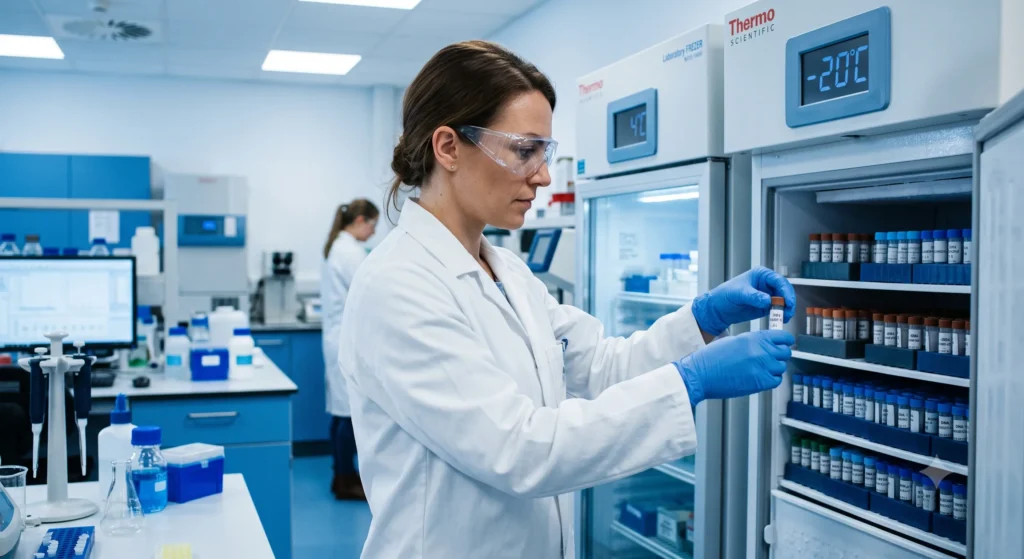
Best Practices for Proper Storage
Temperature plays a critical role in preserving the quality, stability, and integrity of laboratory research materials. Whether working with peptides, proteins, reagents, enzymes, or other sensitive compounds, maintaining appropriate storage temperatures helps minimize degradation and supports consistent research outcomes.
Understanding how temperature influences laboratory materials allows researchers to establish reliable storage practices that protect valuable samples throughout their lifecycle.
Why Temperature Matters
Many research materials are sensitive to environmental conditions. Exposure to temperatures outside recommended ranges may affect their physical or chemical characteristics over time.
Proper temperature management can help:
- Preserve sample integrity
- Reduce degradation
- Maintain consistency between experiments
- Extend storage life where appropriate
- Support reliable laboratory research
Temperature control should always follow manufacturer recommendations and institutional laboratory procedures.
Common Laboratory Storage Temperature Ranges
Different laboratory materials may require different storage environments depending on their characteristics.
Typical laboratory storage categories include:
Room Temperature (15°C–25°C)
Suitable for many laboratory supplies, documentation, and certain stable reagents.
Examples include:
- Laboratory consumables
- Glassware
- Some buffers and solutions
- Equipment manuals and documentation
Always verify whether specific research materials are approved for room-temperature storage.
Refrigerated Storage (2°C–8°C)
Many laboratory reagents benefit from refrigeration to help maintain stability during short-term storage.
Refrigerated storage is commonly used for:
- Selected research reagents
- Certain biological materials
- Prepared laboratory solutions
- Quality control standards
Laboratory refrigerators should be monitored regularly using calibrated thermometers or digital monitoring systems.
Frozen Storage (-20°C)
Many laboratories use standard laboratory freezers for longer-term preservation of temperature-sensitive materials.
Good practices include:
- Organizing samples in clearly labeled containers
- Minimizing freezer door openings
- Maintaining accurate inventory records
- Monitoring freezer performance routinely
Consistent freezer temperatures help reduce unnecessary sample stress.
Ultra-Low Temperature Storage (-80°C)
Ultra-low temperature freezers are commonly used in research laboratories for highly temperature-sensitive biological materials.
Typical applications include:
- Long-term sample preservation
- Biological reference materials
- Research specimens requiring enhanced stability
These specialized freezers should undergo regular maintenance and temperature verification.
Avoid Temperature Fluctuations
One of the most important aspects of laboratory storage is maintaining stable temperatures.
Frequent warming and cooling cycles may contribute to changes in certain sensitive research materials.
Researchers can reduce temperature fluctuations by:
- Planning sample retrieval before opening storage units
- Keeping storage doors closed whenever possible
- Returning materials promptly after use
- Using organized storage systems to reduce search time
Consistency is often more beneficial than frequent temperature changes.
Laboratory Temperature Monitoring
Routine monitoring helps ensure storage equipment continues operating within expected ranges.
Many laboratories utilize:
- Digital temperature displays
- Data loggers
- Continuous monitoring systems
- Alarm systems for temperature deviations
- Scheduled manual temperature checks
Maintaining accurate records supports quality assurance and laboratory compliance programs.
Organizing Temperature-Sensitive Materials
Efficient organization reduces unnecessary exposure during sample retrieval.
Helpful practices include:
- Clearly labeling storage containers
- Grouping similar materials together
- Recording storage locations
- Using inventory management software when available
- Rotating inventory according to laboratory procedures
Well-organized storage improves efficiency while helping maintain stable environmental conditions.
Transportation Considerations
Temperature management should continue whenever research materials are transported between laboratories or storage locations.
Depending on laboratory requirements, transportation may involve:
- Insulated shipping containers
- Refrigerated packaging
- Temperature-monitoring devices
- Protective secondary containment
Careful transportation planning helps preserve sample quality during transit.
Equipment Maintenance
Reliable storage begins with properly maintained equipment.
Laboratories should regularly:
- Inspect refrigerators and freezers
- Verify temperature calibration
- Clean condenser coils where applicable
- Check door seals
- Test alarm systems
- Maintain backup power procedures
Preventive maintenance reduces the likelihood of unexpected temperature excursions.
Documentation and Record Keeping
Temperature management should be supported by thorough documentation.
Recommended records include:
- Daily temperature logs
- Equipment maintenance schedules
- Calibration certificates
- Inventory records
- Incident reports for temperature deviations
- Corrective action documentation when necessary
Accurate records support traceability and laboratory quality systems.
Best Practices for Temperature Management
Developing consistent laboratory procedures helps protect valuable research materials.
Key recommendations include:
- Follow manufacturer storage instructions.
- Use calibrated temperature-monitoring devices.
- Minimize unnecessary temperature fluctuations.
- Label all materials clearly.
- Maintain organized storage systems.
- Inspect storage equipment regularly.
- Document all temperature monitoring activities.
- Train laboratory personnel on proper storage procedures.
These practices contribute to maintaining the integrity of laboratory research materials over time.
Conclusion
Temperature is one of the most important environmental factors affecting the preservation of laboratory research materials. By maintaining appropriate storage conditions, monitoring equipment performance, organizing inventories effectively, and following established laboratory procedures, researchers can support consistent sample quality and improve the reliability of scientific investigations.
Effective temperature management is an essential component of good laboratory practice and plays a significant role in protecting valuable research assets.