FOR RESEARCH SCIENTIFIC STUDIES ONLY- NOT FOR HUMAN/ANIMAL CONSUMPTION/USE
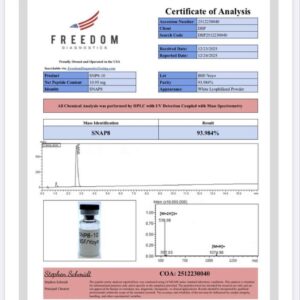
Every batch of Labrat Peptides undergoes third-party Mass Spectrometry and HPLC analysis. We believe in absolute transparency - since in third-party marketing we need complete confidence.
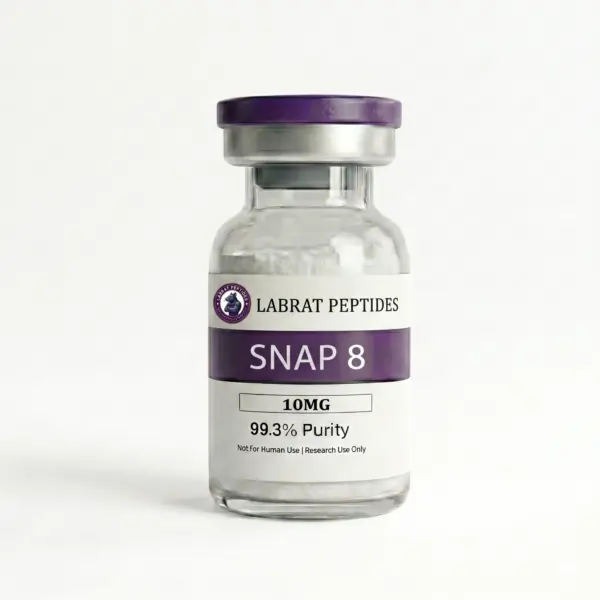
SNAP-8 10MG is a synthetic peptide research material supplied for laboratory investigation, peptide characterization, analytical testing, biochemical research, and cosmetic-peptide research.
SNAP-8 is also known as Acetyl Octapeptide-3 and is an eight-amino-acid peptide designed from a region of SNAP-25, a protein involved in the SNARE complex and neurotransmitter vesicle fusion. The peptide has attracted scientific interest because of its proposed interaction with the molecular machinery involved in neurotransmitter release. Peptides.com
Research involving SNAP-8 is primarily associated with cosmetic peptide research, skin biology, molecular signaling, peptide chemistry, formulation development, and expression-line research.
The proposed mechanism is related to the SNARE complex, but the important distinction is between demonstrating a molecular mechanism in laboratory models and establishing a measurable clinical effect after topical application. Independent evidence specifically evaluating SNAP-8 remains limited. Peptide Science Institute
LabRat Peptides supplies SNAP-8 10MG strictly as a Research Use Only material.
This product is not intended for human consumption, self-administration, injection, therapeutic use, clinical treatment, disease prevention, diagnosis, veterinary use, food applications, or cosmetic application to humans.
Researchers can explore additional Research Peptides and educational resources through the LabRat Peptides Research Hub.
SNAP-8 is a synthetic octapeptide commonly identified by the INCI name Acetyl Octapeptide-3.
It is structurally related to Acetyl Hexapeptide-8, commonly known as Argireline. SNAP-8 extends the shorter peptide sequence and was developed to investigate interactions with the SNARE complex. Peptides.com
The commonly reported sequence for SNAP-8 is:
Ac-Glu-Glu-Met-Gln-Arg-Arg-Ala-Asp-NH₂
SNAP-8 contains eight amino-acid residues and has an N-terminal acetyl group and C-terminal amide.
Its research relevance comes from its relationship to SNAP-25, which forms part of the SNARE protein complex responsible for vesicle docking and neurotransmitter release.
Researchers studying SNAP-8 may therefore investigate:
| Specification | Details |
|---|---|
| Product Name | SNAP-8 10MG |
| Alternative Name | Acetyl Octapeptide-3 |
| Peptide Type | Synthetic octapeptide |
| Sequence | Ac-Glu-Glu-Met-Gln-Arg-Arg-Ala-Asp-NH₂ |
| Peptide Length | 8 amino acids |
| Research Area | Cosmetic peptide / cellular signaling research |
| Quantity | 10MG |
| Application | Laboratory research |
| Classification | Research Use Only |
Researchers should verify molecular identity and analytical specifications against the batch-specific Certificate of Analysis supplied with the product.
SNAP-8 has been designed as a peptide related to the N-terminal region of SNAP-25.
SNAP-25 is one of the proteins involved in the SNARE complex, alongside proteins including syntaxin and synaptobrevin/VAMP. The SNARE complex plays a critical role in the fusion of neurotransmitter-containing vesicles with cell membranes.
The proposed research mechanism for SNAP-8 involves competition with native SNAP-25 within the SNARE assembly process. This mechanism has been investigated in biochemical and laboratory contexts. Peptides.com
However, a molecular mechanism does not automatically establish that a topical product will produce the same effect in human skin.
One of the important research questions surrounding SNAP-8 is therefore delivery and skin penetration.
The SNARE complex is an important molecular system involved in vesicle fusion.
SNARE proteins help facilitate the movement and release of neurotransmitter-containing vesicles.
Because SNAP-8 is modeled on a portion of SNAP-25, researchers have investigated whether the synthetic peptide can interact with the same molecular environment.
Potential research areas include:
This makes SNAP-8 useful as a research model for studying peptide interactions with cellular signaling machinery.
SNAP-8 is particularly associated with cosmetic peptide research.
It has been investigated as an ingredient in topical formulations intended to study the appearance of facial expression lines.
The scientific rationale relates to reducing signaling associated with repeated muscle contraction. However, claims about topical effectiveness should be interpreted carefully because the ability of SNAP-8 to reach the relevant neuromuscular target through intact skin remains an important unresolved question. Peptide Science Institute
Therefore, the most appropriate research applications include:
Skin research involving peptides often focuses on the interaction between peptide chemistry, formulation characteristics, and the skin barrier.
For SNAP-8, researchers may investigate:
The skin barrier presents a significant challenge for peptide delivery because peptides are generally larger and more hydrophilic than many conventional small-molecule cosmetic ingredients.
Consequently, formulation research is an important part of understanding SNAP-8.
SNAP-8 has been marketed within the cosmetic industry for research involving expression lines and wrinkle appearance.
The proposed mechanism relates to modulation of neurotransmitter release and facial-muscle signaling.
However, it is important to distinguish:
Mechanistic research
from
demonstrated clinical efficacy.
Some supplier-sponsored studies have reported changes in wrinkle-depth measurements following topical application, but independent peer-reviewed evidence specifically evaluating SNAP-8 remains limited. Peptides.com
For this reason, LabRat Peptides should present SNAP-8 as a research peptide for cosmetic and biochemical investigation, rather than claiming that it is an established anti-wrinkle treatment.
SNAP-8 is often compared with Argireline, also known as Acetyl Hexapeptide-8.
Both compounds are related to the SNAP-25/SNARE pathway.
However, they are chemically distinct.
| Characteristic | SNAP-8 | Argireline |
|---|---|---|
| Common name | SNAP-8 | Argireline |
| Chemical name | Acetyl Octapeptide-3 | Acetyl Hexapeptide-8 |
| Peptide length | 8 amino acids | 6 amino acids |
| Research area | Cosmetic peptide research | Cosmetic peptide research |
| Molecular target | SNARE-related pathway | SNARE-related pathway |
| Research interest | Expression-line and peptide research | Expression-line and peptide research |
The shorter Argireline peptide has a larger body of published research, whereas independent SNAP-8-specific evidence remains comparatively limited. Peptides.com
Researchers should therefore avoid treating published research on Argireline as direct evidence for SNAP-8.
SNAP-8 10MG may be investigated in several laboratory settings.
Researchers can investigate the physical and chemical properties of the synthetic octapeptide.
Laboratories may use chromatography and mass spectrometry to characterize peptide identity and purity.
SNAP-8 can be studied in experimental topical formulations.
Researchers can investigate how formulation conditions affect peptide distribution and stability.
SNAP-8 can be examined in experimental models involving SNARE-related cellular pathways.
Researchers can investigate degradation under different environmental and formulation conditions.
The relationship between peptide sequence and interaction with molecular targets can be investigated experimentally.
Analytical characterization is an important component of peptide research.
Potential laboratory techniques include:
Published analytical work has investigated methods for measuring Acetyl Octapeptide-3 in cosmetic formulations using liquid-chromatography/mass-spectrometry approaches. Peptides.com
Researchers should use validated analytical methods appropriate to their specific research objectives.
Researchers should review the batch-specific Certificate of Analysis (COA) before using SNAP-8 10MG in laboratory studies.
Depending on the supplier's testing program, a COA may include:
For research purposes, the actual batch documentation should take precedence over generic specifications published on a website.
A Certificate of Analysis provides analytical information associated with a particular batch.
For SNAP-8 10MG, researchers should verify:
Maintaining batch-specific COA records can support research traceability and laboratory documentation.
SNAP-8 10MG should be stored according to the specific manufacturer's instructions and product documentation.
For lyophilized peptide research materials, laboratories should consider:
Research materials should remain properly sealed and protected from unnecessary environmental exposure.
For additional information, visit the LabRat Peptides Research Hub.
You can also link to Understanding Lyophilized Research Materials from this section.
SNAP-8 10MG should be handled by appropriately trained laboratory personnel.
Laboratory procedures should cover:
Because SNAP-8 has primarily been studied in cosmetic/topical contexts, it should not be assumed that evidence relating to topical cosmetic use establishes safety for other routes of exposure. Available literature specifically addressing systemic or injectable use is inadequate. Peptides.com
Researchers interested in SNAP-8 can use scientific databases to locate relevant publications and research information.
Search PubMed for Acetyl Octapeptide-3
These resources can help researchers investigate the underlying biology of SNAP-25, SNARE complexes, and related peptide research.
The current evidence surrounding SNAP-8 should be interpreted carefully.
There is a scientifically plausible mechanism involving the SNARE complex, and supplier-generated cosmetic research has reported changes in wrinkle-depth measurements. However, independent peer-reviewed human evidence specifically isolating SNAP-8's effects remains limited. Peptides.com
Some recent evidence databases identify human studies involving SNAP-8-containing multi-ingredient formulations, but these studies cannot necessarily attribute the observed results to SNAP-8 alone. Peptide Science Institute
This distinction is particularly important for an SEO product page.
Instead of saying:
"SNAP-8 reduces wrinkles."
Use:
"SNAP-8 is researched in cosmetic formulations and has been investigated in relation to expression-line and wrinkle-depth measurements."
That wording is scientifically more defensible.
No.
SNAP-8 and botulinum toxin are fundamentally different substances.
Botulinum toxin is a biologically active neurotoxin that is administered through injection and acts by cleaving SNAP-25.
SNAP-8 is a small synthetic peptide designed to mimic a portion of SNAP-25 and is primarily researched as a cosmetic peptide.
The popular description of SNAP-8 as a "Botox alternative" can therefore be misleading because topical peptide delivery and injectable botulinum toxin treatment involve fundamentally different pharmacological conditions. Peptide Science Institute
For LabRat Peptides, I recommend not using "Botox alternative" as a product claim.
FOR RESEARCH USE ONLY. NOT FOR HUMAN OR VETERINARY USE.
SNAP-8 10MG is supplied as research material for:
This product is not intended for:
SNAP-8 is a synthetic eight-amino-acid peptide also known as Acetyl Octapeptide-3.
SNAP-8 10MG is a 10MG research-material presentation intended for laboratory investigation, peptide characterization, analytical research, and cosmetic formulation research.
Acetyl Octapeptide-3 is the commonly used chemical/INCI name associated with SNAP-8.
SNAP-8 is an octapeptide, meaning it contains eight amino-acid residues.
SNAP-8 is primarily researched in cosmetic peptide science, skin biology, peptide formulation, cellular signaling, and SNARE-related molecular research.
No. SNAP-8 and Argireline are different peptides. SNAP-8 is an eight-amino-acid peptide, while Argireline is Acetyl Hexapeptide-8, a six-amino-acid peptide. Peptides.com
No. SNAP-8 is a synthetic peptide, whereas botulinum toxin is a neurotoxin administered by injection. They have different structures, delivery methods, and pharmacological characteristics.
The evidence specifically attributable to SNAP-8 is limited. Some studies involve SNAP-8 within multi-ingredient cosmetic formulations, making it difficult to isolate the peptide's individual effect. Peptide Science Institute
No. The LabRat Peptides product is supplied strictly for Research Use Only.
Researchers can review scientific publications through PubMed and NCBI.
Visit the LabRat Peptides Research Peptide Collection to explore additional research materials.
Researchers interested in SNAP-8, Acetyl Octapeptide-3, cosmetic peptide research, skin biology, peptide chemistry, cellular signaling, and analytical peptide research can explore the LabRat Peptides Research Peptide Collection.
For additional educational information, visit the LabRat Peptides Research Hub.
Researchers working with lyophilized materials can also review Understanding Lyophilized Research Materials.
FOR RESEARCH USE ONLY. NOT FOR HUMAN OR VETERINARY USE.
SNAP-8 10MG is supplied as laboratory research material for scientific investigation, peptide characterization, analytical testing, cosmetic formulation research, and biochemical studies.
The information presented on this page is intended for scientific and educational purposes only. Research involving SNAP-8 should not be interpreted as evidence of established therapeutic efficacy.
The available evidence specific to SNAP-8 remains limited, and findings from related peptides such as Argireline should not automatically be attributed to SNAP-8.
Researchers are responsible for ensuring that research materials are handled and used according to applicable laws, regulations, institutional requirements, laboratory procedures, and approved research protocols.
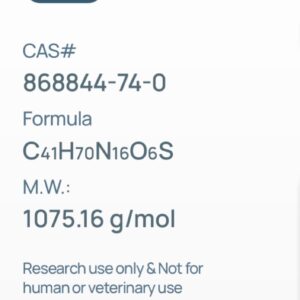
| Sequence | Available on COA |
| Appearance | White Lyophilized Powder |
| Mol. Weight | 1419.6 g/mol |
| Purity | 99.2% |
| Storage | -20°C or below |
| SKU | SNP-8-10M |
All peptides and research chemicals sold on this site are intended exclusively for in-vitro laboratory research. They are not approved for human consumption, medical treatment, veterinary use, or any in-vivo application.