FOR RESEARCH SCIENTIFIC STUDIES ONLY- NOT FOR HUMAN/ANIMAL CONSUMPTION/USE
Every batch of Labrat Peptides undergoes third-party Mass Spectrometry and HPLC analysis. We believe in absolute transparency - since in third-party marketing we need complete confidence.
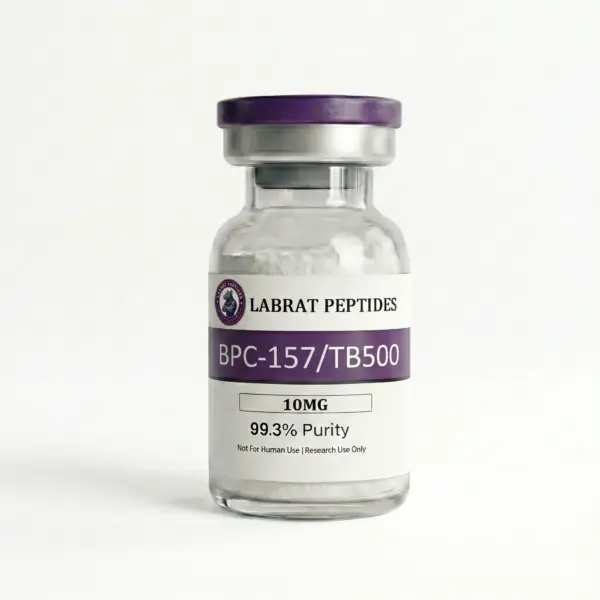
BPC-157/TB500 10MG is a research peptide blend supplied for laboratory investigation, peptide characterization, analytical testing, biochemical research, and controlled scientific studies.
The product combines two distinct research peptides: BPC-157 and TB-500. Although these compounds are frequently discussed together in experimental peptide research, they have different molecular origins and biological research histories.
BPC-157 is a synthetic 15-amino-acid pentadecapeptide that has been investigated primarily in preclinical models. TB-500 is commonly described as a fragment associated with thymosin beta-4, a naturally occurring protein involved in cellular and tissue biology. PubMed Central (PMC)
Research involving these compounds has explored areas including:
A recent rat study evaluated BPC-157, TB-500, and their combination in an Achilles tendon-repair model. The study reported differences in histological and biomechanical outcomes, but it was an animal study, and the combination did not demonstrate additional benefits over the individual compounds. PubMed
Therefore, findings from preclinical research should not be interpreted as evidence that BPC-157/TB500 10MG is effective or safe for human treatment.
BPC-157/TB500 10MG is supplied strictly for Research Use Only.
It is not intended for human consumption, self-administration, therapeutic use, clinical treatment, diagnosis, disease prevention, veterinary use, food applications, or cosmetic applications.
Researchers can explore additional Research Peptides through LabRat Peptides.
BPC-157 is commonly described as a synthetic pentadecapeptide consisting of 15 amino acids.
The compound has attracted scientific interest because of findings reported in experimental models involving gastrointestinal biology, cellular signaling, vascular processes, connective tissues, and other biological systems.
Most of the BPC-157 literature remains preclinical, with substantial research conducted in animal and laboratory models rather than large, well-controlled human clinical trials. A recent review of BPC-157's development noted significant translational barriers and the absence of an approved formulation or validated dosing regimen. PubMed Central (PMC)
Researchers can review the available literature through PubMed – BPC-157 Research.
TB-500 is commonly used to refer to a peptide fragment associated with thymosin beta-4.
Thymosin beta-4 is a naturally occurring protein involved in cellular processes such as actin regulation, cell migration, and tissue biology. TB-500 products are generally discussed in research contexts involving the biological pathways associated with thymosin beta-4.
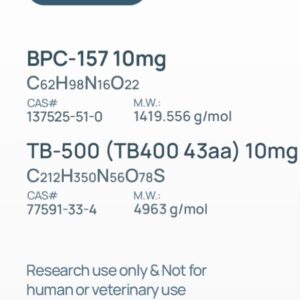
Importantly, the terminology around TB-500 can vary between suppliers and scientific sources. Researchers should therefore verify the exact chemical identity, sequence, molecular mass, and formulation against the product's Certificate of Analysis.
The FDA has specifically noted that thymosin beta-4 fragment (LKKTETQ), also known as TB-500, presents characterization and immunogenicity considerations and that human exposure information is inadequate. U.S. Food and Drug Administration
Although BPC-157 and TB-500 are often marketed together, they should not be treated as the same compound.
| Characteristic | BPC-157 | TB-500 |
|---|---|---|
| Research identity | BPC-157 | TB-500 |
| Peptide type | Pentadecapeptide | Thymosin beta-4 fragment |
| Peptide length | 15 amino acids | Commonly described as 7 amino acids for the LKKTETQ fragment |
| Research area | Cellular and tissue biology | Cellular and tissue biology |
| Research status | Primarily preclinical | Limited human data |
| Primary interest | Cellular signaling and tissue models | Thymosin beta-4-related pathways |
| Intended use | Laboratory research | Laboratory research |
The exact composition of a BPC-157/TB500 blend should always be confirmed using the product-specific COA.
Researchers may investigate the blend in experimental studies involving:
BPC-157 and TB-500 can serve as research compounds for investigating peptide-mediated biological processes.
Laboratory models can be used to investigate signaling pathways associated with cellular migration, extracellular-matrix biology, and tissue responses.
Both peptides have attracted interest in experimental studies involving tendons, ligaments, connective tissues, and extracellular-matrix organization.
Researchers may investigate cellular processes associated with tissue remodeling and repair.
The individual peptides can be characterized using analytical techniques such as chromatography and mass spectrometry.
Researchers may investigate whether simultaneous exposure to BPC-157 and TB-500 produces biological responses that differ from those observed with either compound individually.
Importantly, current evidence does not establish that combining the two compounds produces superior results. A recent rat Achilles-tendon study specifically found no additional benefit from the combination compared with the individual treatments. PubMed
BPC-157 has been studied extensively in experimental animal models.
Research has investigated the compound in relation to:
A systematic review of BPC-157 research in orthopaedic and sports-medicine contexts found that the evidence base is predominantly preclinical and emphasized the lack of an FDA-approved indication. PubMed Central (PMC)
This makes BPC-157 a potentially interesting research model, but it does not establish clinical effectiveness.
TB-500 research is associated with the broader scientific literature surrounding thymosin beta-4 and its fragments.
Research involving thymosin beta-4 has examined cellular mechanisms including:
TB-500 itself should be distinguished from full-length thymosin beta-4.
This distinction is particularly important when documenting laboratory materials because peptide identity, sequence, molecular weight, and formulation affect analytical characterization.
One of the most prominent areas of experimental interest surrounding these peptides is connective-tissue research.
Laboratory and animal studies have examined processes involving:
A 2026 rat study evaluated BPC-157 and TB-500 following Achilles tendon repair. Researchers reported improvements in several histological parameters, while TB-500 also demonstrated a significant biomechanical difference in the study model. The combined treatment did not provide additional benefits over the individual treatments. PubMed
Because this was an exploratory animal study, the results should be considered hypothesis-generating rather than evidence of human therapeutic efficacy.
Cellular signaling is another important research area.
Researchers can investigate how peptide compounds interact with cellular pathways associated with:
The ability to study these pathways under controlled conditions makes peptide compounds valuable research tools.
However, the presence of a biological effect in an experimental model does not necessarily translate into a clinically meaningful effect in humans.
Analytical characterization is particularly important for peptide blends.
Researchers evaluating BPC-157/TB500 10MG may use techniques such as:
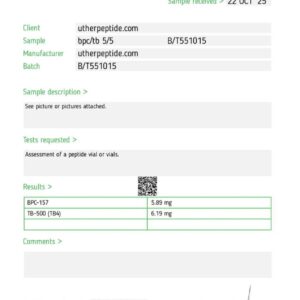
For a blend containing two peptides, analytical testing should ideally distinguish the individual components rather than relying on a single combined purity value.
Researchers should consult the batch-specific Certificate of Analysis for the actual product specifications.
Quality control is an essential part of laboratory peptide research.
The relevant batch documentation may include:
For a blended product, researchers should pay particular attention to whether the COA identifies the individual components and their respective quantities.
Do not publish a specific purity percentage or BPC-157/TB-500 ratio unless it is supported by the actual batch documentation.
A Certificate of Analysis (COA) provides batch-specific information about a research material.
For BPC-157/TB500 10MG, researchers should ideally verify:
A COA should correspond to the exact lot being used in laboratory research.
Maintaining batch-specific documentation helps researchers maintain proper material traceability.
BPC-157/TB500 10MG should be stored according to the specific manufacturer's documentation and batch COA.
For lyophilized peptide materials, laboratories should consider:
Research materials should remain appropriately sealed and protected from unnecessary environmental exposure.
For general educational information, visit the LabRat Peptides Research Hub.
You can also read Understanding Lyophilized Research Materials for general information about laboratory research-material handling.
BPC-157/TB500 should be handled by appropriately trained laboratory personnel.
Researchers should follow institutional procedures covering:
The FDA has raised specific concerns regarding BPC-157 and TB-500, including limited safety information and potential issues involving immunogenicity, peptide impurities, and API characterization. U.S. Food and Drug Administration
Accordingly, laboratories should use appropriate controls and validated analytical methods.
Researchers can access peer-reviewed literature through established scientific databases.
Search PubMed for BPC-157 and TB-500
A recent animal study investigated BPC-157, TB-500, and their combination in an Achilles tendon model. Researchers can review the publication on PubMed. PubMed
Researchers can also review the FDA information on bulk drug substances for regulatory and safety context. U.S. Food and Drug Administration
FOR RESEARCH USE ONLY. NOT FOR HUMAN OR VETERINARY USE.
BPC-157/TB500 10MG is supplied as laboratory research material for scientific investigation, analytical testing, peptide characterization, biochemical research, and cellular/tissue research.
This product is not intended for:
Scientific literature presented on this page is provided for research and educational purposes only.
BPC-157/TB500 10MG is a research peptide blend containing BPC-157 and TB-500 for laboratory investigation and analytical research.
BPC-157 is a synthetic 15-amino-acid peptide that has primarily been investigated in preclinical research models.
TB-500 is commonly used to describe a fragment associated with thymosin beta-4. The exact identity and sequence should be verified against the product's COA.
No. They are chemically distinct peptides with different research histories and molecular characteristics.
Both compounds have attracted research interest in cellular and tissue biology, particularly experimental connective-tissue research. However, this does not establish that combining them provides additional biological or therapeutic benefit.
A recent rat Achilles-tendon study evaluated BPC-157, TB-500, and the combination. The study did not find additional benefits from the combination compared with the individual treatments. PubMed
No FDA-approved indication exists for BPC-157. The FDA has also identified limited safety information and potential concerns relating to immunogenicity and peptide characterization. U.S. Food and Drug Administration
TB-500 is not an FDA-approved therapeutic product. The FDA has noted limited human exposure information for thymosin beta-4 fragment/TB-500. U.S. Food and Drug Administration
No. This LabRat Peptides product is supplied strictly for Research Use Only and is not intended for human or veterinary use.
Researchers can search PubMed for BPC-157.
Researchers can search PubMed for TB-500.
Researchers interested in BPC-157, TB-500, peptide biology, cellular signaling, connective-tissue research, biochemical research, analytical peptide testing, and laboratory research materials can explore the LabRat Peptides Research Peptide Collection.
For educational resources, visit the LabRat Peptides Research Hub.
For general information about research-material storage, read Understanding Lyophilized Research Materials.
FOR RESEARCH USE ONLY. NOT FOR HUMAN OR VETERINARY USE.
BPC-157/TB500 10MG is supplied as laboratory research material for scientific investigation, analytical testing, peptide characterization, cellular research, and biochemical studies.
The information provided on this page is intended for scientific and educational purposes only. Existing evidence for BPC-157 and TB-500 is largely preclinical, and the available human safety and efficacy data are limited. PubMed
Researchers are responsible for ensuring that research materials are handled and used in accordance with applicable laws, regulations, institutional policies, laboratory procedures, and approved research protocols.
| Sequence | Available on COA |
| Appearance | White Lyophilized Powder |
| Mol. Weight | 1419.6 g/mol |
| Purity | 99.2% |
| Storage | -20°C or below |

All peptides and research chemicals sold on this site are intended exclusively for in-vitro laboratory research. They are not approved for human consumption, medical treatment, veterinary use, or any in-vivo application.