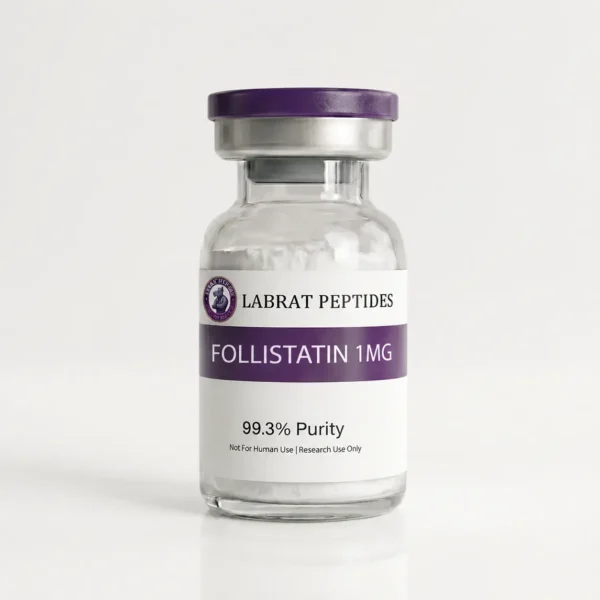
Every batch of Labrat Peptides undergoes third-party Mass Spectrometry and HPLC analysis. We believe in absolute transparency - since in third-party marketing we need complete confidence.
Follistatin 1MG is a research-grade protein material supplied for controlled laboratory research, scientific investigation, analytical testing, and biochemical research applications.
Follistatin is a naturally occurring protein associated with the FST gene. According to the National Center for Biotechnology Information (NCBI), the human FST gene encodes follistatin and produces alternatively spliced protein isoforms. NCBI also identifies follistatin as an activin-binding protein. (NCBI FST Gene).
Scientific literature has extensively investigated the relationship between follistatin and activin signaling. Research has characterized follistatin as an activin-binding protein capable of forming complexes with activin and modulating its biological activity. (PubMed – Follistatin and Activin).
LabRat Peptides supplies Follistatin 1MG as a Research Use Only (RUO) material for qualified research environments. This product is not intended for human consumption, self-administration, therapeutic use, clinical treatment, diagnostic use, veterinary applications, or food use.
Researchers can explore additional materials through the Research Peptides Collection and access educational resources through the LabRat Peptides Research Hub.
Follistatin is a biologically relevant protein that has been studied extensively in molecular biology, endocrinology, cell signaling, and protein interaction research.
The human FST gene is classified by NCBI as a protein-coding gene. NCBI records multiple follistatin transcript and protein variants, including FST317 and FST344. (NCBI Gene – FST).
Follistatin research is particularly relevant to studies examining the interaction between follistatin and members of the TGF-β superfamily, including activin.
Researchers studying protein interactions may use characterized follistatin research material as part of controlled laboratory workflows involving protein-binding studies, biochemical characterization, analytical testing, and molecular research.
For additional scientific information, researchers can review the NCBI FST gene record.
Follistatin has been investigated for its ability to interact with activin.
A peer-reviewed review indexed by PubMed describes follistatin as a specific binding protein for activin and discusses the formation of follistatin-activin complexes. (PubMed).
Other research has examined how follistatin can interfere with activin interaction with its receptors. A study published in Molecular and Cellular Endocrinology reported that follistatin inhibited activin binding to activin type II receptors in experimental systems. (PubMed).
Research has also investigated the structural determinants involved in follistatin's interaction with activin. A study published in the Journal of Biological Chemistry examined the N-terminal region of follistatin and identified residues important for activin binding. (PubMed).
These scientific findings provide useful background for researchers investigating:
Researchers can review additional peer-reviewed literature through PubMed Follistatin Research.
One of the most extensively researched aspects of follistatin biology is its interaction with activin.
Follistatin can bind activin and form a protein complex. Scientific research has investigated how this interaction can influence the availability of activin for receptor binding. (PubMed).
The relationship between follistatin and activin makes follistatin research material relevant to laboratory investigations involving:
Researchers can investigate interactions between follistatin and activin using appropriate biochemical and analytical methods.
Follistatin research can contribute to studies examining signaling pathways involving activin and related proteins.
Follistatin provides a research model for studying protein structure, expression, binding characteristics, and biological signaling.
Researchers may investigate the molecular characteristics of follistatin using appropriate analytical techniques.
Because activin signaling involves receptor interactions, follistatin research can be relevant to controlled investigations of activin receptor pathways.
For additional scientific background, see the NCBI FST Gene Database.
| Specification | Details |
|---|---|
| Product Name | Follistatin 1MG |
| Product Type | Research Protein |
| Quantity | 1MG |
| Research Classification | Research Use Only |
| Primary Research Area | Protein & Molecular Research |
| Research Applications | Biochemical and analytical research |
| Packaging | Research laboratory vial |
| Intended Users | Qualified research laboratories and scientific institutions |
Important: Any stated purity percentage should be verified against the batch-specific Certificate of Analysis (COA) for the actual Follistatin 1MG batch.
Quality control and analytical documentation are important when selecting follistatin research material.
Researchers should evaluate the documentation associated with the specific batch, including applicable analytical testing and product specifications.
Depending on the material and testing program, analytical characterization may include techniques such as:
Researchers should review the applicable COA before incorporating Follistatin 1MG into a laboratory workflow.
Explore additional Research Peptides and available research documentation from LabRat Peptides.
Follistatin 1MG is intended for controlled scientific research and analytical applications.
Potential research areas include:
The appropriate application depends on the researcher's experimental objectives, laboratory equipment, approved procedures, and applicable institutional requirements.
Follistatin research should be performed by qualified personnel using appropriate laboratory procedures.
The human FST gene encodes follistatin, and NCBI identifies follistatin as a protein-coding gene product involved in activin-related biological processes. NCBI also lists activin binding activity and activin receptor antagonist activity among the functional annotations associated with FST. (NCBI FST).
The molecular biology of follistatin has therefore been an important research subject in studies involving:
For researchers conducting literature reviews, the NCBI FST Gene Database provides genomic, transcript, protein, and reference information.
Proper storage and handling are important for maintaining the integrity of protein-based research materials.
Researchers should always follow the specific storage instructions supplied with the product and applicable batch documentation.
General laboratory considerations include:
For additional educational information, visit the LabRat Peptides Research Hub, which includes resources covering research, storage and handling, and laboratory safety.
Researchers can also review Understanding Lyophilized Research Materials for additional information about laboratory storage considerations.
Follistatin 1MG should be handled in an appropriate laboratory environment by qualified personnel.
Researchers should follow their institution's applicable safety procedures, risk assessments, handling requirements, and applicable regulations.
Appropriate laboratory practices may include:
For educational resources, visit the Laboratory Safety section of the LabRat Peptides Research Hub.
A Certificate of Analysis (COA) provides important batch-specific information about research material quality and analytical testing.
Researchers should review the applicable COA for their specific Follistatin 1MG batch before beginning laboratory work.
A COA may provide information such as:
For additional research materials and available documentation, visit the LabRat Peptides Research Peptides Collection.
LabRat Peptides focuses on research-oriented materials for qualified laboratories, scientific institutions, and research organizations.
Follistatin 1MG is positioned as a research material for investigators interested in protein biology, activin research, molecular biology, biochemical investigation, and analytical research.
Researchers can benefit from a research-focused product structure that emphasizes:
Explore the complete Research Peptides Collection for additional laboratory research materials.
Follistatin is a protein encoded by the human FST gene. NCBI identifies FST as a protein-coding gene and describes follistatin as an activin-binding protein. (NCBI).
Follistatin has been investigated extensively in relation to activin binding, protein-protein interactions, signaling pathways, and molecular biology. (PubMed).
Follistatin 1MG refers to a research material supplied in a 1MG quantity for controlled laboratory research and scientific investigation.
Follistatin is more accurately described as a protein/glycoprotein research material rather than treating the product simply as a conventional short peptide. NCBI's FST record identifies follistatin as a protein-coding gene product. (NCBI).
Scientific research describes follistatin as an activin-binding protein. Follistatin can bind activin and influence its availability for receptor interaction. (PubMed).
Researchers can review peer-reviewed publications through PubMed and genomic/protein information through NCBI.
No. Follistatin 1MG is supplied strictly as a Research Use Only material and is not intended for human consumption, self-administration, therapeutic use, or clinical treatment.
Additional laboratory materials are available through the LabRat Peptides Research Peptides Collection.
Visit the LabRat Peptides Research Hub for educational resources relating to research, laboratory safety, storage, handling, and scientific investigation.
Researchers interested in Follistatin research, research proteins, research peptides, activin research, and laboratory research materials can explore the complete LabRat Peptides Research Catalog.
For educational resources, visit the Research Hub.
For laboratory storage information, read Understanding Lyophilized Research Materials.
FOR RESEARCH USE ONLY. NOT FOR HUMAN OR VETERINARY USE.
Follistatin 1MG is supplied as a laboratory research material for scientific investigation, analytical testing, and biochemical research. It is not intended for human consumption, self-administration, therapeutic use, clinical treatment, diagnosis, prevention of disease, veterinary use, cosmetic use, or food applications.
Researchers and institutions are responsible for ensuring that all research materials are handled and used in accordance with applicable laws, regulations, institutional requirements, laboratory safety procedures, and approved research protocols.
| Sequence | Available on COA |
| Appearance | White Lyophilized Powder |
| Mol. Weight | 1419.6 g/mol |
| Purity | 99.2% |
| Storage | -20°C or below |

All peptides and research chemicals sold on this site are intended exclusively for in-vitro laboratory research. They are not approved for human consumption, medical treatment, veterinary use, or any in-vivo application.