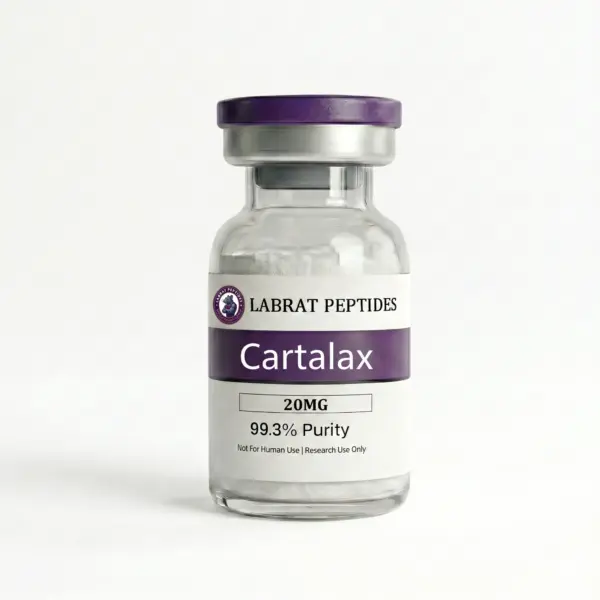
Not for human consumption this product is intended for laboratory/research only
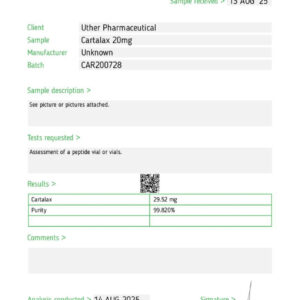
Every batch of Labrat Peptides undergoes third-party Mass Spectrometry and HPLC analysis. We believe in absolute transparency - since in third-party marketing we need complete confidence.
Cartalax 20MG is a synthetic short-peptide research material supplied for controlled laboratory investigation, analytical testing, biochemical research, and scientific study.
Current research-oriented sources commonly identify Cartalax as the short peptide Ala-Glu-Asp (AED), also referenced in some literature and databases as T-31. It is part of the broader family of short synthetic peptides associated with the Khavinson research program. citeturn0search0turn0search2turn0search7
The published evidence surrounding the AED peptide is primarily preclinical and laboratory-based. Available reports include in-vitro studies involving cultured cells and experimental tissue models. These findings should be regarded as laboratory observations rather than evidence of clinical efficacy or therapeutic benefit. citeturn0search2turn0search7
LabRat Peptides supplies Cartalax 20MG strictly as a Research Use Only (RUO) material. It is not intended for human consumption, self-administration, therapeutic use, clinical treatment, diagnosis, disease prevention, veterinary use, or food applications.
Researchers can explore additional Research Peptides and scientific resources through the LabRat Peptides Research Hub.
Cartalax is a short synthetic peptide associated with the family of peptide bioregulators developed and investigated within the Khavinson research tradition.
Several current research references identify Cartalax as the Ala-Glu-Asp (AED) tripeptide. Some sources also identify it using the research designation T-31. citeturn0search0turn0search2turn0search7
Because commercial sources have published conflicting descriptions of Cartalax, researchers should verify the identity of their specific material using the product label, batch documentation, Certificate of Analysis, and mass-spectrometry results.
This distinction is particularly important for research peptides because even a single additional amino-acid residue can result in a materially different molecular composition and molecular weight.
Research involving the AED peptide has primarily been conducted in laboratory and cell-culture settings.
Potential areas of scientific investigation include:
The available literature should be evaluated carefully because the evidence base for Cartalax specifically is limited and largely associated with experimental laboratory models. citeturn0search2turn0search7
Researchers should not interpret experimental findings as evidence of a therapeutic effect in humans.
For additional scientific literature, researchers can search PubMed for Cartalax and PubMed for Ala-Glu-Asp.
Cartalax is generally discussed within the broader group of short synthetic peptides associated with tissue and cellular research.
Research-oriented literature describes the AED peptide as a three-amino-acid sequence:
Ala – Glu – Asp
or:
AED
Some research sources also refer to it as T-31. citeturn0search2turn0search7
The short size of the peptide makes it useful for controlled research investigating relationships between peptide structure, molecular characteristics, and cellular processes.
Researchers studying Cartalax may therefore be interested in:
Characterization of short peptide sequences and their associated molecular properties.
Investigation of peptide-related molecular interactions and cellular processes.
Experimental evaluation of peptide-related observations in controlled cell-culture environments.
Assessment of peptide identity, purity, and molecular characteristics using suitable analytical techniques.
The available scientific record for Cartalax is relatively limited compared with more extensively studied research peptides.
Current research summaries describe published AED work involving experimental systems such as:
These studies are primarily laboratory investigations and should not be interpreted as evidence that Cartalax has an established clinical application. citeturn0search2turn0search7
Researchers conducting literature reviews should distinguish between studies that specifically investigate AED/Cartalax and studies concerning other peptides in the same broader peptide-bioregulator family.
For current biomedical literature, visit PubMed.
| Specification | Details |
|---|---|
| Product Name | Cartalax 20MG |
| Product Type | Synthetic Research Peptide |
| Quantity | 20MG |
| Common Research Identification | Cartalax / AED |
| Reported Sequence | Ala-Glu-Asp (AED)* |
| Peptide Length | 3 amino acids* |
| Research Classification | Research Use Only |
| Intended Application | Laboratory & Analytical Research |
| Form | Lyophilized research material where applicable |
*Confirm the exact identity and specifications against the batch-specific COA and mass-spectrometry report supplied with your product.
Quality verification is important when selecting Cartalax research material.
Researchers should review the analytical documentation associated with the exact batch before using the material in a laboratory workflow.
Depending on the applicable testing program, analytical characterization may include:
A Certificate of Analysis should be matched to the exact product name, lot number, and batch supplied.
If your product's COA reports a specific purity percentage, that percentage can be added to the product specifications and SEO content. I would not publish a generic 98%, 99%, or 99.3% purity claim unless your actual Cartalax batch COA confirms it.
Researchers can explore additional Research Peptides from LabRat Peptides.
The Certificate of Analysis (COA) is an important document for research-material traceability and quality verification.
Researchers should review the applicable COA before beginning laboratory work.
Depending on the testing performed, a COA may include:
For research laboratories, keeping the COA together with the corresponding product batch can help maintain accurate research records and material traceability.
Research peptides should be stored according to the specific product documentation and batch COA.
For lyophilized research materials, researchers should consider the applicable requirements for:
Keep the container properly sealed and follow the storage conditions specified for the particular batch.
For educational information about laboratory research materials, visit the LabRat Peptides Research Hub.
You can also read Understanding Lyophilized Research Materials for additional information about lyophilized laboratory materials.
Cartalax 20MG should be handled only by qualified personnel in an appropriate laboratory environment.
Researchers should follow their institution's laboratory safety procedures, applicable regulations, risk assessments, and product-specific documentation.
General laboratory practices may include:
For additional educational resources, visit the LabRat Peptides Research Hub.
Researchers interested in Cartalax and AED-related research can use authoritative scientific databases to investigate the available literature.
Researchers can search PubMed for Cartalax and PubMed for Ala-Glu-Asp.
The National Center for Biotechnology Information (NCBI) provides access to biomedical literature, molecular databases, and other scientific resources.
Researchers can use PubChem to investigate chemical identifiers and molecular information when a verified compound record is available.
These resources provide independent scientific information that can help researchers conduct literature reviews and verify molecular information.
Cartalax 20MG is supplied strictly for laboratory research and analytical investigation.
This material is not intended for:
Researchers and institutions are responsible for ensuring that research materials are handled and used in accordance with applicable laws, regulations, institutional requirements, laboratory procedures, and approved research protocols.
Cartalax is a short synthetic research peptide commonly identified as Ala-Glu-Asp (AED). Some research-oriented sources also refer to it as T-31. citeturn0search0turn0search7
Cartalax 20MG is a 20MG presentation of Cartalax research material intended for controlled laboratory investigation and analytical research.
Current research-oriented sources commonly identify Cartalax as Ala-Glu-Asp (AED). Because conflicting commercial descriptions exist, researchers should verify the exact sequence against the product's batch-specific COA and mass-spectrometry results. citeturn0search0turn0search2
Yes. Cartalax is commonly described as a synthetic short peptide or tripeptide. citeturn0search0turn0search2
The published AED literature is primarily laboratory-based and includes studies involving cultured cells and experimental tissue models. Current evidence does not establish a therapeutic or clinical application for Cartalax. citeturn0search2turn0search7
No established human therapeutic approval was identified in the sources reviewed. Current evidence is predominantly preclinical and laboratory-based. citeturn0search2turn0search7
Current research summaries indicate that there is no established controlled human clinical evidence for Cartalax. The available published work is primarily laboratory and cell-culture research. citeturn0search2turn0search7
No. Cartalax 20MG is supplied strictly for Research Use Only and is not intended for human or veterinary use.
Researchers can search PubMed for Cartalax, PubMed for Ala-Glu-Asp, and broader scientific information through NCBI.
Additional laboratory research materials are available through the LabRat Peptides Research Peptides Collection.
Visit the LabRat Peptides Research Hub for educational resources relating to research peptides, laboratory safety, storage, handling, and scientific investigation.
Researchers interested in Cartalax research, AED peptide research, short synthetic peptides, peptide characterization, laboratory research materials, and biochemical investigation can explore the complete LabRat Peptides Research Peptides Collection.
For educational resources, visit the Research Hub.
For information about lyophilized research materials, read Understanding Lyophilized Research Materials.
FOR RESEARCH USE ONLY. NOT FOR HUMAN OR VETERINARY USE.
Cartalax 20MG is supplied as a laboratory research material for scientific investigation, analytical testing, and biochemical research. It is not intended for human consumption, self-administration, therapeutic use, clinical treatment, diagnosis, prevention of disease, veterinary use, cosmetic use, or food applications.
The scientific information presented on this page summarizes available research literature and should not be interpreted as a claim that Cartalax is effective, safe, approved, or clinically useful for treating any condition.
| Sequence | Available on COA |
| Appearance | White Lyophilized Powder |
| Mol. Weight | 1419.6 g/mol |
| Purity | 99.2% |
| Storage | -20°C or below |

All peptides and research chemicals sold on this site are intended exclusively for in-vitro laboratory research. They are not approved for human consumption, medical treatment, veterinary use, or any in-vivo application.